
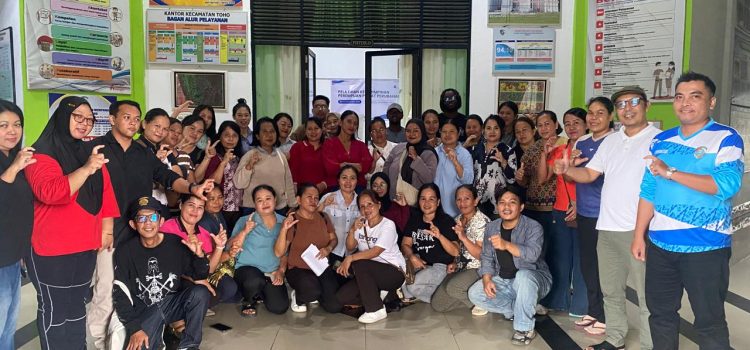
MEMPAWAH – Women farmers play a vital role in the social and economic life of rural communities, particularly in managing natural resources and ensuring household food security. However, their contributions have not always been matched by equal opportunities to participate in community leadership and village-level decision-making. Strengthening women’s leadership capacities is therefore an important step toward promoting more inclusive and sustainable change.
To address this need, Gemawan organized a Women Change Agents Leadership Training program on November 5–6, 2026. Held at the Toho District Office Hall in Mempawah Regency, the training brought together women farmers and community activists from 15 villages across Toho, Anjungan, and Sadaniang districts.
The training aimed to strengthen women farmers’ capacities to lead and organize their communities, identify local challenges, map available resources and opportunities, and develop collective actions that respond to community needs.
Through these efforts, women are encouraged to move beyond their traditional roles in household activities, agriculture, and local economic production to take a more strategic role in shaping village development.
Hermawansyah, a member of Gemawan’s Governing Board, emphasized in his opening remarks that community participation, particularly the involvement of women farmers, is essential to achieving sustainable natural resource management.
According to him, development policies and programs are unlikely to achieve their intended outcomes if they overlook the communities that live alongside and depend directly on natural resources.
He highlighted the recent impacts of forest and land fires on both urban and rural communities. Beyond disrupting daily activities, the resulting haze has affected household economic activities and children’s access to education.
“Any policy or program concerning natural resource management will struggle to succeed if it does not involve the communities that interact directly with those resources. This is especially true when programs fail to address household economic challenges, particularly those faced by women farmers in rural villages,” Hermawansyah said.
He added that women farmers should not be viewed merely as beneficiaries of development programs. They are important actors who possess the knowledge, experience, and potential to lead meaningful change.
For this reason, women’s empowerment should begin within their immediate communities by strengthening groups, organizations, and local institutions capable of representing and advocating for the interests and needs of rural residents.
Strengthening Leadership, Entrepreneurship, Agroecology, and Technology
Through the training, Gemawan focused on strengthening four interconnected areas: leadership, entrepreneurship, agroecology, and technology.
Leadership development was designed to improve women’s ability to organize themselves and their communities. Entrepreneurship focused on strengthening productive economic activities based on local resources and opportunities.
Agroecology encouraged agricultural practices that prioritize environmental sustainability, while technology focused on introducing practical tools and approaches to support farming activities.
Hermawansyah, affectionately known as Wawan, encouraged participants to begin by recognizing the challenges in their own communities, identifying available resources, and developing collective strategies for change.
He emphasized that existing women’s groups should continue to strengthen their organizations, while women who have not yet joined a group could begin establishing collective platforms suited to the needs and conditions of their villages.
“Ultimately, you are the agents of change. Gemawan is here as a facilitator to accompany and support that process. So, let us identify the challenges around us, recognize the potential we have, and work together to develop solutions to the problems our communities face,” he said.
Collaboration as a Foundation for Sustainable Village Development
Meanwhile, Toho District Secretary Teguh Dewantoro, representing the Head of Toho District, officially opened the training and expressed his appreciation for Gemawan’s initiative to strengthen the capacities of women farmers in Toho and surrounding areas.
According to Teguh, regional development requires the participation of multiple stakeholders and cannot rely on government efforts alone.
Collaboration among government institutions, civil society organizations, and local communities is essential to ensuring that development initiatives respond to local needs and make effective use of available resources.
He described the training as an opportunity for women farmers to broaden their knowledge, exchange experiences, and identify both opportunities and challenges in natural resource management within their respective communities.
“We greatly appreciate this initiative. Regional development requires synergy, collaboration, and mutual cooperation among different stakeholders. Through this training, we hope participants will learn together, strengthen their capacities, and gain a better understanding of how to manage village resources wisely and sustainably,” Teguh said.
He also encouraged participants to take an active role throughout the training by engaging in discussions and sharing ideas and experiences based on the conditions in their villages.
Teguh emphasized that the knowledge gained should not remain confined to the training sessions but should be translated into practical action, including more environmentally friendly agricultural land management and disaster mitigation efforts.
He expressed hope that partnerships among the district government, village administrations, local communities, and Gemawan would continue to grow stronger as part of broader efforts to improve community well-being.
Empowering Women to Shape the Future of Their Communities
Through this training, Gemawan hopes that women farmers will develop greater confidence and stronger capacities to lead their communities, establish productive enterprises, adopt sustainable agricultural practices, and advocate for their interests in decision-making forums, including village deliberation meetings.
Strengthening women’s leadership is an essential part of building villages that are inclusive, empowered, and sustainable.
Women farmers not only make substantial contributions to household economies, food security, and natural resource management but also have the rights, knowledge, and abilities to influence the direction of development in their communities.
By supporting women as leaders and agents of change, the initiative seeks to create greater opportunities for their voices, experiences, and aspirations to shape decisions that affect their lives.
The training also reinforces the importance of collective action, recognizing that lasting change in rural communities grows through cooperation, shared learning, and the active participation of those who understand local challenges firsthand.
Ultimately, strengthening women’s leadership means recognizing women farmers not simply as contributors to village development, but as people with the capacity and the right to help determine their communities’ future.