
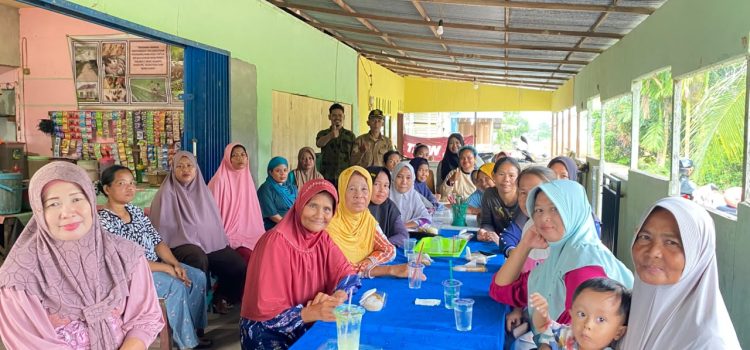
MEMPAWAH – Efforts to improve farmers’ knowledge and skills in managing rice pests and diseases were carried out through a Rice Pest Management Training program held on October 30–31, 2026, in Peniti Dalam 1 and Peniti Dalam 2 villages, Mempawah Regency, West Kalimantan.
The training brought together members of Women’s Farmer Groups (Kelompok Wanita Tani, KWT), local farmer groups, Agricultural Extension Officers (Penyuluh Pertanian Lapangan, PPL) from Segedong District, and Plant Pest and Disease Control Officers (Pengendali Organisme Pengganggu Tumbuhan, POPT).
A total of 39 participants attended the two-day training, comprising 15 participants from Peniti Dalam 1 Village and 24 participants from Peniti Dalam 2 Village.
The program aimed to strengthen farmers’ ability to identify different types of pests and recognize symptoms of pest attacks on rice crops. It also encouraged the adoption of Integrated Pest Management (IPM) practices and stronger cooperation among farmers in monitoring and controlling pests collectively.
Water Availability Remains a Major Challenge for Rice Farmers
During the training session in Peniti Dalam 1 Village, participants discussed various challenges affecting rice cultivation in their communities.
Feriyandi, an Agricultural Extension Officer from Segedong District, explained that one of the main challenges facing local farmers was limited access to freshwater.
“The geographical conditions of this area, where water sources have high salt concentrations, mean that farmers depend heavily on rainfall to irrigate their rice fields. When there is no rain for one or two weeks, the available water can become saline, potentially disrupting rice growth,” Feriyandi explained.
In addition to discussing water availability, participants learned about the use of certified rice seeds and the differences between seed certification labels.
According to the training materials, purple-labeled seeds can be used for up to three planting cycles, while blue-labeled seeds are intended for a single planting cycle under the applicable guidelines.
Another topic introduced during the training was the jajar legowo rice planting system, an alternative planting arrangement designed to support increased rice productivity.
This method can improve air circulation and sunlight exposure, make crop maintenance easier, and help reduce the risk of pests and diseases spreading between plants.
Encouraging Integrated Pest Management and Coordinated Planting
Sukarman, a Plant Pest and Disease Control Officer (POPT), delivered a session on threats posed by fungal, viral, and bacterial infections that can interfere with rice growth.
He also highlighted the challenges associated with farmers following different planting schedules.
“During this session, much of our discussion focused on planting patterns that have not yet been coordinated among farmers. Farmers in both Peniti Dalam 1 and Peniti Dalam 2 generally harvest rice only once a year. This remains one of the challenges in improving agricultural productivity,” Sukarman said.
Agricultural Extension Officers encouraged farmers to strengthen coordination through their farmer groups, particularly in reaching agreements on synchronized planting schedules.
Planting rice at the same time is expected to make land management more efficient and facilitate collective efforts to control pests and crop diseases.
However, determining suitable planting schedules must also take into account weather conditions and water availability to ensure that rice cultivation can proceed effectively.
Strengthening Women’s Farmer Groups Through Practical Learning
Beyond technical training, the program provided an opportunity to encourage farmers, particularly members of Women’s Farmer Groups, to apply their newly acquired knowledge in their own fields.
Feby, a Gemawan activist involved in facilitating the groups, emphasized the importance of continued mentoring and cooperation among farmers.
“As a group facilitator, I support and assist farmers, particularly members of Women’s Farmer Groups, in participating in training on rice pest and disease management. Through this activity, I hope participants can strengthen their knowledge and skills in identifying symptoms of pest attacks and crop diseases, understanding Integrated Pest Management practices, and applying what they have learned in their own farming activities,” Feby said.
She also highlighted the importance of collective action in addressing agricultural challenges.
“I also encourage farmer groups and Women’s Farmer Groups to continue strengthening communication, coordination, and cooperation, especially in reaching agreements on synchronized planting schedules as one way to reduce the risk of pest and disease outbreaks in rice crops,” she added.
Through the training, farmers gained not only technical knowledge about pest and disease management but also opportunities to identify agricultural challenges in their respective villages and explore possible solutions through collective discussions.
The participatory approach allowed farmers to share their experiences, discuss local farming conditions, and consider practical improvements that could be implemented together.
The training is expected to contribute to strengthening the capacities of farmers, particularly local farmer groups and Women’s Farmer Groups, in addressing rice cultivation challenges.
By improving pest and disease management practices, encouraging coordinated planting, and strengthening cooperation among farmers, the initiative aims to support more productive and sustainable rice farming in Peniti Dalam 1 and Peniti Dalam 2 villages.
Ultimately, the program highlights the importance of combining technical agricultural knowledge with community participation to help rural farmers develop more resilient and sustainable livelihoods.