
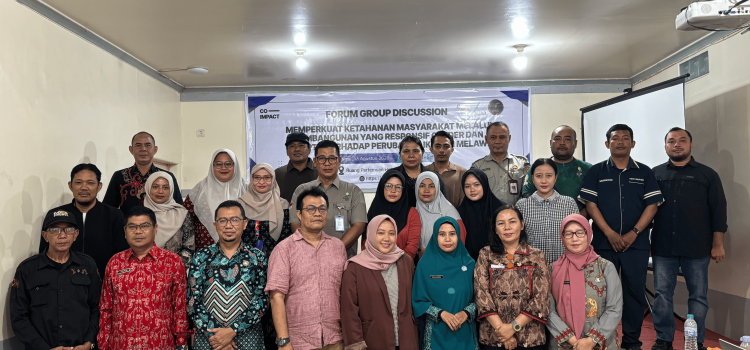
NANGA PINOH – Gemawan is working to strengthen the role of women farmers through multi-stakeholder collaboration in Melawi Regency, West Kalimantan. The initiative was discussed during a Multi-Stakeholder Focus Group Discussion (FGD) titled “Strengthening Women Farmers Through Multi-Stakeholder Collaboration in Melawi Regency,” held at the Rajawali Hotel Ballroom in Nanga Pinoh on Thursday, August 13, 2026.
The discussion was organized as part of broader efforts to strengthen community resilience through gender-responsive development and climate change adaptation.
Dozens of participants attended the event, representing regional government agencies (OPD), civil society organizations, women farmers’ groups from several villages, youth communities, academic institutions, and the media.
The FGD also formed part of Gemawan’s efforts to promote systemic change through its 3R approach: Recognition, Representation, and Redistribution. This approach aims to strengthen the identity, independence, and empowerment of women farmers.
The event provided a space for participants to develop a shared understanding that empowering women farmers is not the responsibility of any single institution but a collective priority.
Women farmers should not be viewed merely as beneficiaries of development programs. They are also economic actors, food producers, managers of local resources, and essential contributors to regional development.
The FGD aimed to identify both the challenges and opportunities facing women farmers in managing natural resources sustainably.
The event was officially opened by Uray Endang Kusumajaya, a member of Gemawan’s Governing Board. In his remarks, he emphasized the importance of multi-stakeholder collaboration in strengthening the position of women farmers amid various social, economic, and environmental challenges.
According to Uray Endang, women farmers play a strategic role in maintaining household food security and ensuring the sustainability of natural resources. However, they continue to face barriers, including limited access to land, restricted participation in decision-making, and inadequate gender-responsive policies.
During the presentation session, Rahmawati, Program Manager of Gemawan, delivered a presentation titled “Strengthening Women Farmers Through Multi-Stakeholder Collaboration in Melawi Regency.”
Rahmawati explained that women make substantial contributions throughout the agricultural sector, from production and processing agricultural products to maintaining environmental sustainability.
For this reason, women farmers need greater support through capacity building, access to technology, stronger economic enterprises, and meaningful participation in policymaking at both village and regional levels.
“Strengthening women farmers must become a shared agenda. When women have equal access and opportunities, food security, household economies, and environmental sustainability will become stronger,” Rahmawati said.
She added that the FGD should produce more than general agreements or statements of commitment.
Instead, the forum was expected to develop a concrete collaborative action plan outlining the responsibilities of each stakeholder, forms of support, implementation timelines, and indicators that could be jointly monitored.
Building Stronger Collaboration at the Local Level
Gemawan’s local partners in Melawi Regency, SUAR and Benih, also participated in the initiative.
Sukartaji, Chairperson of SUAR, expressed hope that the FGD would establish a foundation for collaboration aimed at developing stronger and more empowered women farmers, particularly in Melawi Regency.
According to Sukartaji, empowered women farmers are characterized by stronger leadership, growing agricultural enterprises, the adoption of sustainable farming practices, the ability to utilize technology, and well-established networks with regional government agencies.
He explained that the collaboration seeks to strengthen women farmers’ position as key actors in agricultural development, local economic growth, food security, and sustainable environmental management.
Meanwhile, Kornelius, Chairperson of Benih, emphasized that the initiative did not begin with the FGD. The program had already been underway for approximately two months, including direct engagement with women who would become its primary participants.
Kornelius, affectionately known as Toi, explained that his organization had established communication with women’s groups across several villages.
“We have been communicating with women’s groups and have visited at least seven villages. These are villages where we have previously carried out community assistance activities,” he explained.
The discussion was interactive, with participants sharing insights and recommendations on the challenges women farmers continue to face.
Key concerns included limited market access, difficulties obtaining business capital, inadequate land protection, the impacts of climate change, the need for more inclusive policies, and the importance of conducting land assessments.
In addition to Gemawan, the event featured speakers from several Melawi Regency Government institutions, including the Regional Development Planning, Research and Innovation Agency (Bapperida), the Agricultural Extension Center, and the Food Security and Agriculture Office.
Through this multi-stakeholder dialogue, Gemawan and its local partners sought to encourage stronger coordination among government institutions, civil society organizations, and women farmers’ groups.
The collaboration is expected to support the development of more inclusive agricultural policies, strengthen women’s economic opportunities, and promote sustainable natural resource management in Melawi Regency.
Source: Melawi News