
Tackling forest and land fires (Karhutla) in West Kalimantan requires preparedness and support from multiple stakeholders. As dry-season conditions increase the risk of fires across several areas, strengthening response capacity—including the availability of firefighting equipment and logistical supplies—has become increasingly important.
As of September 1, 2026, a total of 38,310 hectares of land had been affected by fires across West Kalimantan. Ketapang Regency recorded the largest burned area at 12,443.79 hectares, followed by Kubu Raya at 6,814.31 hectares and Mempawah at 6,144.98 hectares.
Fires were also recorded in several other areas, including North Kayong with 4,228.10 hectares, Sambas with 2,318.48 hectares, Bengkayang with 1,596.15 hectares, Landak with 853.68 hectares, Sanggau with 620.88 hectares, Kapuas Hulu with 450.38 hectares, Singkawang with 377.76 hectares, Pontianak with 295.29 hectares, Melawi with 172.21 hectares, Sintang with 139.98 hectares, and Sekadau with 55.03 hectares.
The scale of the affected area highlights that responding to forest and land fires requires not only well-prepared personnel on the ground but also adequate firefighting equipment and logistical support. Limited equipment can hinder the initial response when fires break out and increase the risk of the flames spreading further.
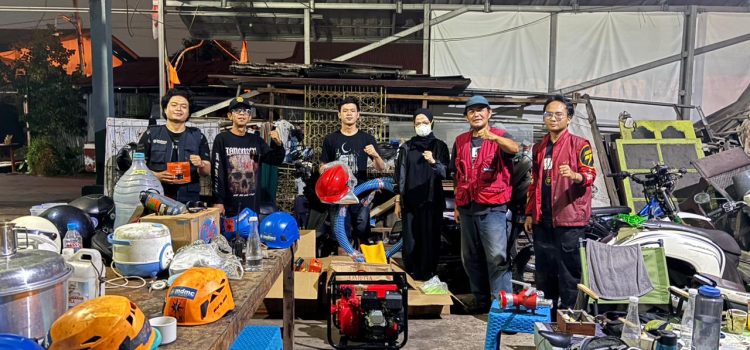
In response to the situation, Gemawan distributed firefighting equipment and logistical supplies to volunteers from the West Kalimantan Muhammadiyah Disaster Management Center (MDMC) on Tuesday evening, September 1, 2026.
The assistance included water pumps, fire hoses, boots, protective goggles, helmets, gloves, bottled drinking water, and other essential logistical supplies.
The assistance is part of efforts to strengthen volunteers’ capacity to respond to fires more quickly, particularly when incidents require immediate intervention.
The availability of proper equipment is a critical factor in responding to forest and land fires. The ability of personnel to reach affected locations quickly must be supported by adequate firefighting capacity, access to water sources, and safety equipment that enables volunteers to work safely and effectively.
For this reason, supporting volunteers should not be viewed merely as providing equipment, but as part of a broader effort to build a more prepared fire-response system at the grassroots level. Tackling fires during their early stages is crucial to preventing them from growing and spreading over larger areas.
Previously, Gemawan had also promoted stronger forest and land fire response through Community Fire Awareness Groups (MPA) in several villages. These efforts reflect concern over the threat of forest and land fires, which require more serious, coordinated action involving various stakeholders at the community level.
Strengthening community capacity is particularly important because villages are among the areas closest to potential fire hotspots. With sufficient knowledge, preparedness, and access to proper equipment, communities and volunteers are better positioned to take swift action when signs of fire are detected.
The firefighting equipment distributed by Gemawan, funded through donations collected for the initiative, is expected to serve a purpose beyond the handover itself. The equipment is intended to be used effectively to support volunteers in the field and strengthen their capacity to respond to forest and land fires when incidents occur.
Gemawan activist Arni said the organization remains committed to playing an active role in addressing forest and land fire issues in West Kalimantan, including by providing support in areas where gaps remain.
“Amid the severe fires occurring in West Kalimantan, Gemawan remains committed to playing its part and working to fill the gaps where support is still needed,” Arni said.
According to her, one form of this support is strengthening organizations that coordinate firefighting volunteers.
“We understand that the strength to control fires today lies in the hands of communities. Local communities understand the conditions of their environment and, importantly, possess ecological knowledge of their own areas,” she said.
At the same time, Arni stressed the importance of viewing the forest and land fire issue in a broader context. She said communities should not be left to continually bear the burden of problems and policies that do not reflect the needs of people at the grassroots level.
“On the one hand, we understand that these fires are not caused solely by communities. Yet communities are often the ones who bear a disproportionate burden from policies that are not rooted in grassroots needs,” she emphasized.
Efforts to strengthen the capacity of volunteers and local communities form part of Gemawan’s commitment to building collaboration in addressing forest and land fires. Volunteers, civil society organizations, community groups, government institutions, and village communities all have complementary roles to play in both preventing and responding to fires.
With better equipment and continuously strengthened community capacity, responses to forest and land fires are expected to become faster, safer, and more systematic. Early intervention remains one of the key measures for preventing fires from expanding into larger incidents while reducing their impacts on the environment, public health, and the lives of people living in and around affected areas.
Writer: Izhar