
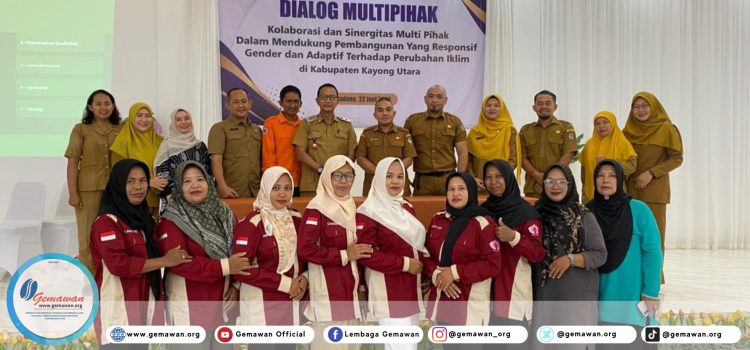
The commitment to strengthening inclusive, gender-responsive, and climate-adaptive development in North Kayong Regency has been further reinforced through the signing of Memorandums of Understanding (MoUs) between Gemawan and the Department of Social Affairs, Women’s Empowerment, Child Protection, Community Empowerment and Villages (SP3APMD) of North Kayong Regency, as well as between Gemawan and the Department of Cooperatives, SMEs, Industry and Trade of North Kayong Regency.
The MoU signing took place as part of a Focus Group Discussion (FGD) titled “Multi-Stakeholder Collaboration and Synergy in Supporting Gender-Responsive and Climate-Adaptive Development in North Kayong Regency,” held on Monday, June 22, 2026.
The agreements were signed directly by the respective department heads as a manifestation of their shared commitment to strengthening strategic partnerships between local government and civil society in supporting the sustainable development agenda.
This activity served as a dialogic space that brought together various stakeholders to align perceptions, strengthen coordination, and formulate collaborative steps in addressing development challenges, particularly issues of gender inequality, food security, community economic empowerment, and the impacts of climate change that are increasingly tangible at the local level.
The event was officially opened by the Secretary of the Regional Development Planning, Research and Innovation Agency (Bapperida) of North Kayong Regency, Mr. Galih Tosan, and was attended by various Regional Apparatus Organizations (OPDs) and related institutions, including the Regional Disaster Management Agency (BPBD), the Forest Management Unit (KPH), the Department of Environment and Forestry, the Department of Cooperatives, SMEs, Industry and Trade, the Department of SP3APMD, the Department of Agriculture and Food, and the Agricultural Extension Division of North Kayong Regency.
Also present at the event were commodity-based farmer community networks, the Chairperson of the North Kayong Regency Women’s Union (SETARA), women’s village groups, Gemawan’s assisted communities, and various civil society elements that have been actively promoting equitable and sustainable development.
In his address, Galih Tosan stated that the North Kayong Regency Government has integrated gender perspectives into various regional development planning documents.
According to him, gender mainstreaming is no longer a sectoral issue but has become an essential part of regional development policy as outlined in the Regional Medium-Term Development Plan (RPJMD) documents.
He emphasized that every development planning process must ensure the involvement of all community groups, including women, so that the benefits of development can be enjoyed equitably.
This approach is considered important for creating more inclusive development while simultaneously enhancing the region’s capacity to address various social, economic, and environmental challenges.
A similar view was expressed by the Head of Division at the Department of SP3APMD of North Kayong Regency, Yuni, who affirmed that regional development must be grounded in the principle of gender mainstreaming to ensure equal access, equal opportunities, meaningful participation, and equitable development benefits for all members of society.
According to her, the future direction of strengthening gender mainstreaming in North Kayong Regency includes strengthening sex-disaggregated data, integrating gender perspectives into the RPJMD and RKPD (Regional Work Plan), enhancing the capacity of regional apparatus, strengthening women’s participation in the development process, and integrating gender issues into climate change adaptation programs.
She also conveyed a number of strategic recommendations, including the establishment of a cross-sectoral coordination forum, strengthening gender and climate databases, increasing women’s involvement in development planning deliberations (Musrenbang) and village planning, developing gender-inclusive green economy initiatives, strengthening the role of the business sector through gender-responsive corporate social responsibility (CSR) programs, and enhancing women’s capacity in facing the risks and impacts of climate change.
Source: Harian Berkat