
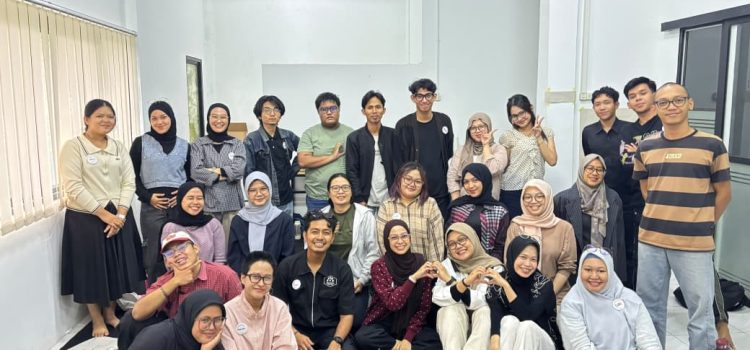
PONTIANAK – A total of 55 young people participated in two batches of RE:MAKING SOCIETY: Social Innovators for Democracy, Human Rights & Environmental Justice, organized by Gemawan under the Indonesia Civil Society Forum (ICSF) Kalimantan initiative. Each batch consisted of two full days of learning, held on October 16–17, 2026 (Batch 1) and October 23–24, 2026 (Batch 2). The first batch brought together 25 in-person and 15 online participants, while the second batch involved 15 in-person participants.
The program provided a collaborative learning space for young people to explore the interconnected issues of democracy, human rights, and environmental justice. These three issues are closely intertwined, particularly as democratic decline, violations of citizens’ rights, and natural resource exploitation continue to affect communities across Indonesia, including Kalimantan.
As a region facing the expansion of extractive industries, agrarian conflicts, deforestation, and recurring ecological crises, Kalimantan needs learning spaces that encourage young people to critically examine these challenges. Such spaces allow participants to look beyond the visible impacts and explore the power relations, economic interests, and policies that shape these issues.
Through RE:MAKING SOCIETY, participants engaged in a series of learning sessions connecting democracy, human rights, and environmental justice with Indonesia’s broader sociopolitical dynamics. Topics included the concepts, principles, and practices of democracy and human rights; the threats of militarism and authoritarianism; political ecology; social movements; and envisioning the future of Kalimantan and Indonesia.
On the first day, discussions focused on democracy and human rights, including the threats posed by militarism and authoritarianism and the importance of good governance. Participants were encouraged to examine how power relations and governance practices influence the protection of citizens’ rights and opportunities for public participation.
The second day continued with sessions on political ecology, social movements, and imagining the future of Kalimantan and Indonesia. Participants explored the relationships between nature, power, and economic interests, including how the expansion of extractive industries and historical legacies have shaped contemporary environmental challenges. Discussions on social movements also provided opportunities to examine different forms of resistance and collective strategies for driving social change.
The program featured speakers from diverse backgrounds, including academics, civil society activists, and practitioners involved in advocacy and community organizing. These different perspectives enriched the learning process and allowed participants to connect theoretical concepts with real-world challenges faced by communities.
Beyond attending presentations, participants took part in case study discussions, reflection sessions, and exchanges of experiences. These activities encouraged them to relate the lessons to their respective movements and explore opportunities for collaboration across issues and geographical areas.
Arni, Coordinator of Gemawan’s Training and Learning Center, explained that RE:MAKING SOCIETY emerged from reflections on the importance of learning spaces rooted in civil society movements. Amid growing concerns about shrinking democratic space, such initiatives are seen as a way to sustain social movements and bridge generational gaps.
“Why did we create this program? Because we reflected on how important it is to build learning spaces that are grounded in social movements as a way of sustaining the movement today. At a time when democratic space is increasingly under threat, we must continue bridging the generational gap. For us, organizing this class is a starting point to encourage young people to revisit theories and principles so they can develop new ideas,” Arni explained.
She expressed hope that the 55 young participants who completed the two batches would grow into social innovators capable of contributing to democracy and creating new opportunities for change.
“We hope these 55 young people will become social innovators who can reclaim spaces that rightfully belong to us. We, the younger generation, are the ones who will shape the future,” she added.
Ammar, one of the participants, described the program as an opportunity to meet new people and learn directly from experienced practitioners.
“It was a warm and enjoyable experience. I had a valuable opportunity to meet new friends, learn from practitioners with expertise in their respective fields, and participate in case study discussions on various issues affecting Indonesia,” Ammar shared.
Meanwhile, another participant, Ovy, highlighted discussions on democratic inequality, human rights challenges, and political ecology as experiences that broadened her perspective on environmental issues in Kalimantan.
“First of all, I was happy to be part of this learning space. What stood out to me on the first day was the discussion about democratic inequality and human rights issues in Indonesia, including the government’s inadequate handling of various problems,” Ovy said.
She also noted that the political ecology session on the second day offered a new perspective on understanding environmental challenges in Kalimantan, particularly through a historical lens.
“The political ecology session on the second day was particularly interesting. I enjoyed learning to understand West Kalimantan from a historical perspective, especially in relation to the expansion of oil palm plantations and the legacy of colonialism. As a sociology student, this perspective enriched the way I understand environmental issues. In a sense, we were also engaging in decolonization by critically examining knowledge shaped by the effects of colonialism,” she continued.
Participants’ experiences demonstrated the importance of learning spaces that go beyond delivering information. Such spaces create opportunities to question perspectives, engage in meaningful discussions, and understand complex issues through the experiences of others. Learning about democracy, human rights, and environmental justice becomes part of developing critical awareness while strengthening grassroots social initiatives.
Through the two batches of RE:MAKING SOCIETY, Gemawan sought to bring together young people from diverse backgrounds to develop shared understanding and expand networks across different issues. These encounters are expected to serve as a starting point for new ideas, initiatives, and collaborations that can strengthen civil society movements in Kalimantan.
The initiative aligns with Gemawan’s vision of building a vibrant, inclusive, and sustainable Borneo through local community empowerment, environmental sustainability, and policy advocacy. By strengthening young people’s capacities and networks, learning spaces such as RE:MAKING SOCIETY are expected to contribute to a more democratic, just, and sustainable future.
Written by: Dastin