
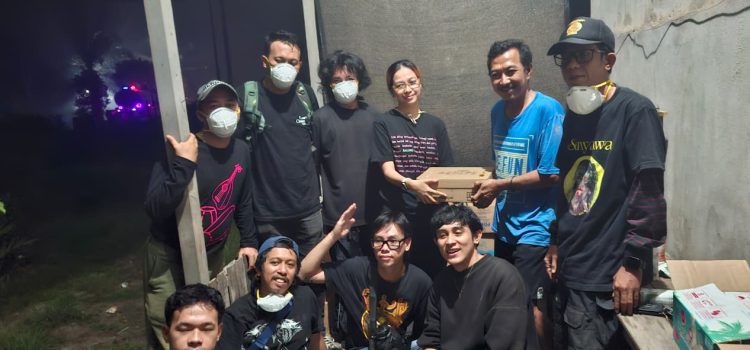
Tackling forest and land fires requires not only firefighting equipment but also support for communities and volunteers on the front lines. In response, Masyarakat Siaga Asap (Masa) Kalimantan Barat–Gemawan, together with Radio Showcase and Books for Borneo through the Perjalanan Mengenal Borneo initiative, distributed assistance to community fire brigades (MPA) and volunteers in Re’es Hamlet, Teluk Bakung Village, and Panca Maju Hamlet, Pancaroba Village, Sungai Ambawang Subdistrict, Kubu Raya Regency, on Saturday (September 12, 2026).
The distribution was part of the West Kalimantan Forest and Land Fire Solidarity Action, organized under the initiatives “Sound of Earth” and “Books for Borneo” to demonstrate solidarity with communities affected by forest and land fires across the province.
The initiative went beyond fundraising, providing direct assistance to communities and volunteers who face flames, smoke, extreme heat, and challenging firefighting conditions every day.
The assistance included vitamins, masks, bottled water, milk, instant noodles, and other essential supplies. All items were donated by individuals and communities involved in the Sound of Earth and Books for Borneo initiatives.
Social activist Arni said the distribution was intended to provide both moral and material support to firefighters and volunteers who had spent days battling fires despite limited resources.
“We are here to encourage the firefighters and volunteers working to extinguish forest fires. We pray that everyone involved in these firefighting efforts remains healthy and safe.”
According to Arni, responsibility for tackling forest and land fires cannot rest solely on firefighters and community fire brigades. Addressing the situation requires the involvement of various stakeholders, including the government, local communities, civil society organizations, businesses, and other community groups.
Beyond supporting those working on the ground, she emphasized the importance of strengthening environmental awareness, particularly amid extreme drought conditions that increase the risk of fires and make firefighting operations more difficult.
“Amid these extreme drought conditions, we all need to remain committed to protecting the environment. We also hope that rain will arrive soon and help make firefighting efforts more effective,” she said.
Days of Battling the Flames
Re’es Hamlet in Teluk Bakung Village is among the areas still facing significant challenges in tackling forest and land fires. Fires have persisted in the area since they first broke out on August 24, 2026. Several hotspots subsequently emerged in hard-to-reach locations, including forested areas in neighborhood units RT 03 and RT 01.
Difficult terrain remains one of the main obstacles facing firefighting teams. The distance between available water sources and hotspots means that adequate equipment is essential. However, the Re’es community fire brigade continues to face shortages of vehicles and firefighting equipment, particularly hoses long enough to reach several affected locations.
Toni, Head of Re’es Hamlet, explained that these limitations have forced firefighters to work harder to bring the fires under control.
“We have had considerable difficulty reaching the affected areas because of our limited equipment and vehicles. Our hoses are currently too short, making it difficult to access the water needed for firefighting,” he said.
During the initial outbreak, firefighting efforts were primarily carried out by the Re’es community fire brigade alongside the fire brigade from PT GAN. As the situation intensified, several firefighting organizations and Indonesian National Armed Forces (TNI) personnel also joined operations at various locations.
The Re’es community fire brigade was established around 2023–2024 and remains active in responding to fires. However, its operations still depend heavily on voluntary contributions from local residents.
Fuel, food, drinks, and other operational necessities are provided through community contributions and mutual assistance.
“Some people buy fuel, while others voluntarily prepare meals and coffee. Everything comes from the community’s own contributions,” Toni explained.
Limited Equipment and Essential Supplies
Shortages extend beyond firefighting vehicles and equipment. Personal protective equipment (PPE) and other safety supplies for those working on the ground also remain a concern.
Requests for assistance, including hoses, PPE, and other safety equipment, had been submitted to companies since August. However, at the time of the interview, the requested assistance had not yet arrived. Support from regional and central governments had also not reached the area.
During firefighting operations that continue for days, access to essential supplies such as drinking water becomes increasingly important. Community fire brigade members and residents must work in extreme heat, endure smoke exposure, and navigate difficult terrain. These conditions have begun to cause physical exhaustion among some of those involved.
“Clean drinking water is what we urgently need,” Toni said.
He hopes that support for firefighting operations can be strengthened, particularly to reach hotspots in forested areas that are difficult to access by land.
According to Toni, the challenge is not simply extinguishing the flames but ensuring that fires do not reignite. Some hotspots have flared up again within minutes of being extinguished.
“We put out the fire, but a few minutes later it starts burning again. We extinguish it, and it reignites. That is one of the things that makes the situation so overwhelming,” he said.
Community Solidarity as a Source of Strength
Forest and land fires have affected not only the environment but also residents’ daily activities. Farming and other livelihoods have been disrupted, while residents directly involved in firefighting operations have had to leave their regular work to help contain the flames.
Amid these challenges, the spirit of gotong royong, or mutual cooperation, has become one of the greatest strengths of the Re’es community. Support does not always come in the form of equipment. Residents also contribute their time, labor, food, drinks, fuel, and vehicles to help transport firefighting equipment.
One resident voluntarily provided a vehicle to transport pumps and hoses during firefighting operations. The vehicle was used for approximately one week without payment or reimbursement for fuel.
“No payment, no wages, and no fuel reimbursement. It was entirely voluntary,” Toni recalled.
For the Re’es community, assistance from various stakeholders is particularly meaningful because it directly addresses the needs of those working on the ground. Logistical supplies help sustain teams engaged in prolonged firefighting operations, while public attention and solidarity provide much-needed encouragement to volunteers.
“We are grateful that people care about our hamlet and the fires we are facing. Assistance like the supplies you have brought is extremely helpful to our teams, especially the firefighters and community members supporting them,” he said.
Solidarity Beyond Donations
The distribution of assistance through Sound of Earth and Books for Borneo is part of a broader effort to strengthen solidarity in responding to forest and land fires across West Kalimantan.
For Radio Showcase, Masyarakat Siaga Asap (Masa) Kalimantan Barat–Gemawan, and everyone involved in both initiatives, supporting firefighting efforts is not simply about delivering assistance after fires have broken out. Solidarity also provides an opportunity to strengthen public awareness of environmental issues and community safety.
The situation in Re’es Hamlet demonstrates how grassroots communities are often the first to respond when fires occur. Working with limited equipment and resources, they rely on mutual cooperation to meet operational needs while dedicating their time, energy, and personal safety to preventing fires from spreading.
Solidarity must therefore translate into sustained support, including logistical supplies, firefighting equipment, protective gear, and stronger community capacity for preventing and responding to forest and land fires.
At the same time, firefighting efforts must go hand in hand with prevention. Local communities, governments, businesses, civil society organizations, and other stakeholders all have a role to play in protecting the environment and reducing fire risks, particularly during the dry season.
Through Sound of Earth and Books for Borneo, organizers hope that solidarity will extend beyond a single aid distribution. The support generated through these collective initiatives serves as a reminder that tackling forest and land fires is a shared responsibility. Those on the front lines should not have to face the crisis alone.
Written by: Izhar