
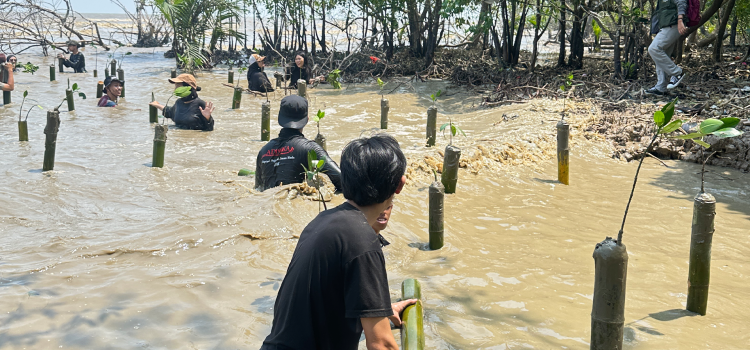
Efforts to protect coastal ecosystems and strengthen shoreline resilience continued through a mangrove planting initiative in Sungai Bakau Kecil Village, Mempawah Timur District, Mempawah Regency, on Sunday (August 9, 2026).
A total of 391 mangrove seedlings were planted in an initiative organized by Group 11 of the 2026 Community Service Program (KKN) of Universitas Muhammadiyah Pontianak (UMP) together with Gemawan. The planting also used 147 bamboo stakes to support the seedlings.
The initiative brought together a wide range of stakeholders, including inTERRAction, WALHI West Kalimantan, Teraju Foundation, UMP KKN students, students participating in the Field Work Program (KKL) from the State Islamic Institute (IAIN) Pontianak, the Sungai Bakau Kecil Village Government, and local residents.
The activity was opened by Haqqi Wirakaryadi, Head of the Village Government Section, representing the Village Head. Also present were UMP KKN Field Supervisor Eka Kurniawan, S.Si., M.Si., and Gemawan Board Member Hermawansyah.
Planting Mangroves, Protecting the Coast and Local Livelihoods
Muhammad Hanif Mustaqim, coordinator of UMP’s KKN Group 11, said the mangrove planting was a concrete contribution by students to protecting the sustainability of the Sungai Bakau Kecil coastline, particularly against the threat of coastal erosion.
“Our main objective today is to take concrete action to preserve the coastline of Sungai Bakau Kecil Village while helping prevent coastal erosion,” Hanif said.
He emphasized that the initiative was made possible through the support and involvement of the village government, universities, civil society organizations, students, and local communities.
“Let us make the effort we put in today an investment in preserving our village’s environment,” he said.
Gemawan Board Member Hermawansyah said coastal protection is closely linked to the lives and livelihoods of people in Sungai Bakau Kecil. With the area facing a high risk of coastal erosion, efforts to restore and protect mangrove ecosystems need to be carried out consistently and sustainably.
Gemawan has a history of community engagement in Sungai Bakau Kecil. The organization previously supported peatland community empowerment through a program of the Peatland and Mangrove Restoration Agency (BRGM). In recent years, Gemawan and Kitabisa.com have also supported pond management and community empowerment initiatives as incentives for fishers who voluntarily commit to protecting coastal ecosystems.
“The threat of coastal erosion is very high, while the natural succession process takes a long time,” Hermawansyah said.
He also highlighted changes in the coastal landscape resulting from natural succession, including a phenomenon locally known as “tanah tumbuh,” referring to newly formed land along the coastline. He said the emergence of such land requires attention and should be managed through agreements between the village government and local communities to prevent future disputes.
“If managed properly, this newly formed land could remain accessible to local communities,” he said.
Hermawansyah described student involvement in mangrove planting as a positive step that should be expanded into a broader movement. Gemawan has previously conducted mangrove planting activities in the village with students from Silva Indonesia and the Faculty of Mathematics and Natural Sciences at Tanjungpura University, as well as through collaborations involving the Indonesian Navy’s Lantamal XII, the Alliance of Independent Journalists (AJI) Pontianak, journalist networks, and civil society activists.
“We hope this program can continue and expand on a much larger scale, because mangroves are a pillar of marine life. If mangroves are damaged, shrimp and crabs will disappear,” he said.
According to Hermawansyah, mangroves do more than protect shorelines from erosion. They also support ecosystems that sustain coastal livelihoods. The presence of shrimp, crabs, and other marine species is closely connected to healthy mangrove ecosystems.
For this reason, mangrove planting should not end with the students’ community service program but should develop into a long-term initiative involving local communities, the village government, universities, and civil society organizations.
From a Student Initiative to Collective Action
UMP KKN Field Supervisor Eka Kurniawan expressed his appreciation for the support provided by the village government and various organizations in helping students implement the initiative.
He said the mangrove planting demonstrated how an idea initiated by students can generate broader impact when carried out collaboratively.
“UMP students started with a small idea, but it can have a significant impact on coastal communities,” he said.
Eka expressed hope that the initiative would continue beyond the completion of Group 11’s community service program, either through future groups of KKN students or local community organizations.
“We hope this will not end with our students, but can be continued by future KKN groups or other community groups so that efforts to prevent coastal erosion can expand and be sustained over time,” he said.
The planting of 391 mangrove seedlings in Sungai Bakau Kecil represents part of a collective effort to address ecological challenges that directly affect the future of coastal communities. The collaboration brought together student initiatives, community experience, village government support, and the work of civil society organizations in protecting the coastal ecosystem.
Amid the threat of coastal erosion and changing coastal landscapes, mangroves remain an essential part of protecting community living spaces. Planting mangroves is therefore not simply about restoring coastal vegetation today, but about safeguarding ecosystems and livelihoods for future generations.