
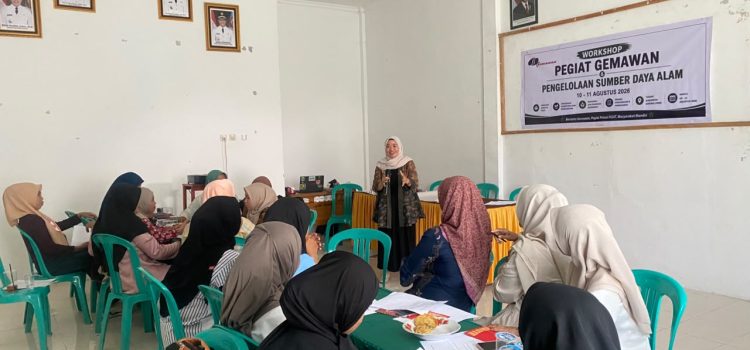
A total of 42 Change Agents from 18 villages in Kayong Utara Regency participated in a capacity-building training organized by Perkumpulan Gemawan on August 10–11, 2026. The participating villages represent approximately 41 percent of the program’s target villages across four districts.
Held across Seponti, Teluk Batang, Sukadana, and Simpang Hilir, the training marked the first stage in building a grassroots network of local change agents. The initiative was carried out through collaboration between Gemawan and the Kayong Utara Regency Government, with support from the Kayong Utara Agriculture, Plantation and Livestock Agency and coordinators of the Agricultural Extension Centers (BPP).
The Change Agents were representatives recommended by their respective village governments. They are being prepared to take active roles in organizing, leading, and developing women’s groups within their communities.
The capacity-building initiative is part of Gemawan’s long-term strategy to promote systemic change in village development and natural resource management through its Recognition, Representation, and Redistribution (3R) approach. This approach seeks to position women not merely as beneficiaries of development, but as active actors with the space, voice, and influence to help shape development priorities in their communities.
During the training, participants strengthened their knowledge and skills in leadership, community organizing, independent enterprise development, agroecological practices, and the inclusive use of technology. They were also trained to identify village-level challenges, encourage community participation, facilitate deliberations, manage conflicts, and formulate initiatives that respond to local social and economic conditions.
The learning process draws on Gemawan’s more than 27 years of experience working alongside communities. Rather than relying solely on theory, the training uses participants’ experiences and real-life community challenges as key learning resources.
Participants are also being prepared to undertake multiple roles, including as enumerators, moderators, facilitators, and initiators of change. These capacities are expected to enable them to connect community needs with available opportunities and resources that can support change at the village level.
Gemawan Senior Activist Maulisa described the training as a form of social investment aimed at developing local leaders capable of driving change from within their communities.
“We want to develop change agents who are capable of organizing communities, particularly women’s groups, so that strong and independent rural women’s movements can emerge and influence the direction of development. The first phase has shown strong enthusiasm, and we will continue with a second phase of training for other villages that are still waiting for the opportunity to join the program,” Maulisa said.
According to Maulisa, efforts to strengthen this movement will initially focus on agriculture initiated and managed by women’s groups in each village. Agriculture was selected as an entry point because it is closely connected to people’s daily lives and has significant potential to strengthen household economies and family welfare.
Participants said the training provided practical knowledge they could apply directly upon returning to their villages.
Suhartini, a Change Agent from Seponti District, said the training was easy to understand because it was grounded in situations participants encounter in their daily lives.
“The training was very focused because all of the materials were developed based on real conditions in the field. We did not only learn theory, but also practical steps for organizing women’s groups. When we return to our villages, we already have a clear picture of what needs to be done,” she said.
Suhartini added that further training and knowledge-sharing processes would strengthen the capacity of the Change Agents to support rural women in organizing themselves and developing sustainable economic initiatives.
Lisma, a Change Agent from Sukadana District, similarly said the training provided new insights into community-organizing strategies, including the importance of paying attention to details that may previously have seemed insignificant.
“This is a very concrete and strategic step. The materials were easy to understand because they were presented systematically. Even small things that we previously overlooked can have a major influence on the success of organizing women’s groups in the villages,” she said.
The participation of 18 villages in the first phase marks the beginning of a broader consolidation process. Gemawan, together with the local government and relevant stakeholders, will continue the capacity-building process to reach other target villages.
Going forward, the 42 Change Agents are expected to develop into a grassroots network capable of sharing knowledge, building and strengthening women’s groups, and initiating changes based on the specific needs of their respective villages.
Through this process, efforts to promote change in Kayong Utara will not rely solely on top-down development programs but will increasingly be built upon the strength of communities themselves. Women farmers are being encouraged to become key drivers of local development, while villages serve as spaces where leadership, ideas, and movements for more inclusive, equitable, and sustainable change can grow.