
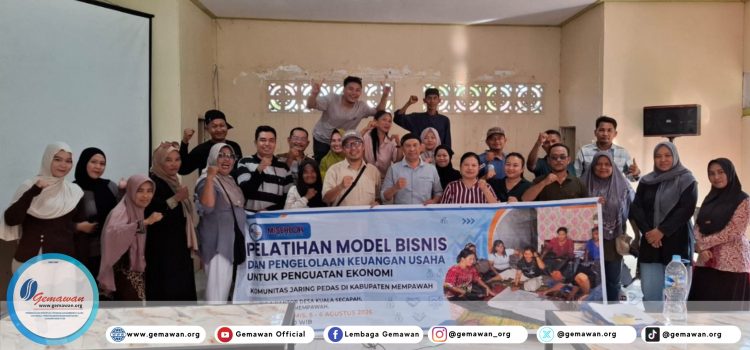
A total of 30 commodity farmers assisted by Gemawan from 15 villages in Mempawah Regency participated in the “Business Model and Business Financial Management Training for Strengthening the Economy of the JARINGPEDAS Community in Mempawah Regency.” The participants came from Wajok Hilir, Peniti Dalam I, Peniti Dalam II, Peniti Besar, Galang, Sungai Rasau, Antibar, Sejegi, Sekabuk, Bumbun, Suak Barangan, Jungkat, Sungai Bakau Besar Darat, Purun, and Kuala Secapah villages.
The training took place over two days, on August 5–6, 2026, at the Kuala Secapah Village Hall, Mempawah Hilir District. The activity was officially opened by the Head of Kuala Secapah Village, Mawardi. Hermawansyah, a member of Gemawan’s Board of Directors, stated that every program implemented by Gemawan is always designed based on an assessment of the real problems faced by the community. Therefore, all activities are designed to address the needs of farmers, both at the local level and within the broader context of agricultural issues.
According to him, the agricultural sector plays a strategic role as a pillar of food security and as a significant contributor to the national economy. However, this sector is currently facing various challenges, ranging from the shrinking of agricultural land due to conversion into residential areas, plantations, and extractive industries. In addition, the regeneration of farmers is also a serious issue. Currently, the majority of farmers are over 50 years old, while interest among the younger generation in farming continues to decline because the agricultural sector is still perceived as unable to provide economic welfare guarantees.
“The most fundamental problem faced by farmers today is the fragility of their household economies. Various development programs will have no impact if they are unable to directly improve farmers’ welfare,” said Wawan, Hermawansyah’s nickname.
He also criticized agricultural development approaches that are more oriented toward large-scale food industrialization, such as corporation-based food estate programs. According to him, such approaches tend to generate greater economic benefits for corporations than for farmers as the main actors in food production.
As part of efforts to strengthen farmers’ economies, Gemawan encourages the enhancement of farmers’ capacity to manage their farming businesses in a more planned manner. Through this training, participants were guided to plan production, estimate potential harvest yields, project income, and manage business and household finances separately so that farming businesses can develop sustainably.
In addition to strengthening business capacity, Gemawan also continues to encourage farmers to build collective power through the Commodity-Based Farmers Network (JARINGPEDAS). According to Hermawansyah, the organization serves as a shared learning space for farmers to exchange information, experiences, and knowledge, thereby strengthening their position and bargaining power.
“With a strong organization, farmers are expected to increase productivity, create added value from agricultural products, and strengthen their household economic resilience,” he concluded.
Business Model to Enhance Capacity
Meanwhile, Lani Ardiansyah, Community Organizer for Gemawan in the Mempawah Region, explained that this training aims to enhance the capacity of JARINGPEDAS administrators and members in developing more focused and sustainable commodity business models. Using the Business Model Canvas (BMC) approach, participants were guided to map business potential, analyze supply chains, determine target markets, and design strategies for developing commodity products with added value.
In addition, the training equipped participants with basic skills in business financial management, including separating household and business finances, preparing simple cash bookkeeping, calculating the Cost of Goods Sold (COGS), and managing cash flow to ensure the business remains healthy and sustainable.
“This training also encourages the creation of structured action plans for developing farmer group business units, thereby strengthening the economic independence and competitiveness of communities based on local potential in each village,” said Lani Ardiansyah, who is familiarly called Ucup.
He added that the expected outcomes of this activity include the formulation of Business Model Canvas (BMC) documents for priority commodities managed by farmer groups that are members of JARINGPEDAS. Furthermore, participants are expected to master various business financial management instruments, such as daily cash bookkeeping, COGS calculation sheets, and monthly cash flow projections.
“Equally important is the emergence of a shared commitment in the form of concrete action plans to develop group business units after this training concludes,” he concluded.
Source: Article titled “30 Petani JARINGPEDAS Mempawah Perkuat Kapasitas Model Bisnis dan Pengelolaan Keuangan Usaha,” full article available at link: https://wartapontianak.pikiran-rakyat.com/kalbar/pr-11710380605/30-petani-jaringpedas-mempawah-perkuat-kapasitas-model-bisnis-dan-pengelolaan-keuangan-usaha?page=all