
PONTIANAK – Rain has begun to fall, and the haze is gradually clearing across several parts of Kalimantan. However, the fading smoke does not mean the forest and land fire crisis has come to an end. The impacts on communities, ecological damage, and persistent governance challenges still demand attention and collective action.
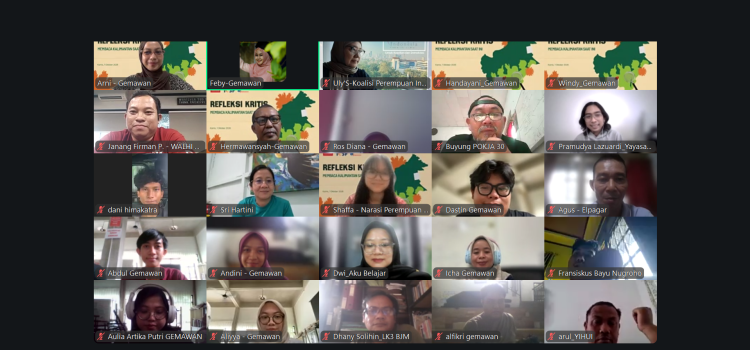
These concerns were among the key issues discussed during an online civil society gathering titled “Critical Reflections: Understanding Kalimantan Today,” held on Thursday, October 1, 2026, as part of the Indonesia Civil Society Forum (ICSF) Kalimantan.
The gathering brought together civil society representatives from different parts of Kalimantan to share their experiences in responding to forest and land fires, examine ongoing challenges, and identify collective actions needed beyond the immediate crisis.
The forum focused not only on understanding the current fire situation but also on reflecting on the responses undertaken by civil society organizations, ranging from monitoring and firefighting to aid distribution, community protection, policy advocacy, and public oversight.
Janang from WALHI Central Kalimantan emphasized that recurring forest and land fires should no longer be addressed only after fires have already broken out. In his view, mitigation and prevention must become central components of forest and land fire governance in Kalimantan.
“Ignoring community rights when discussing forest and land fires means overlooking the need for early mitigation. We have raised this concern repeatedly. We need to demand accountability and push for concrete measures to mitigate disasters, rather than taking action only when fires have already started.”
Janang also stressed that forest and land fires cannot be separated from the deterioration of the environment’s capacity to withstand ecological pressures and from broader governance problems. He argued that the government must learn from recurring disasters and ensure that existing policies are properly implemented.
“We must pay close attention to post-fire conditions. There is a risk that the situation could become chaotic if the government focuses solely on extinguishing fires without considering what happens afterward. We cannot continue repeating the same problems every year without improving governance and strengthening prevention.”
Experiences from disaster response efforts in West Kalimantan were shared by Baruni Hendri from the Muhammadiyah Disaster Management Center (MDMC) West Kalimantan. MDMC responded to the crisis by establishing response posts and providing assistance to affected communities and volunteers in several areas, including distributing masks.
According to Baruni, the fire crisis has also demonstrated the importance of complementary efforts among organizations, communities, and grassroots groups in responding to emergencies.
“The current situation shows just how severely the resilience of our landscapes has deteriorated. One positive example from West Kalimantan is how civil society organizations have complemented one another’s efforts. When Gemawan raises funds while other groups respond directly in the field, this kind of cooperation becomes essential. It allows people to help one another and mobilize rapid responses.”
Beyond emergency response, Baruni emphasized that monitoring and law enforcement must continue even after the fires have subsided.
“We also need to pay attention to law enforcement. We cannot focus solely on whether fires occur on company land or within concession areas. Monitoring efforts must be made transparent, including when discussing post-disaster conditions. Ecological disasters continue to recur in West Kalimantan, which means community resilience must also be rebuilt and strengthened.”
Another perspective came from Shaffa Nadiba, Chair of Narasi Perempuan South Kalimantan, who highlighted the impacts of forest and land fires on women and the often-overlooked burden of care work during disasters.
During a crisis, women face not only health risks from smoke exposure and deteriorating environmental conditions. They also frequently take on the responsibility of ensuring that household needs are met, including when access to clean water becomes increasingly difficult.
“Care work is largely carried out by women as part of the way society is organized. As a result, women often shoulder a double burden, while responsibility for managing health-related impacts also falls on them. These burdens become even heavier when existing governance systems are not gender-responsive.”
Shaffa also drew attention to the experiences of women at the grassroots level who must continue meeting their families’ basic needs as environmental conditions deteriorate. She argued that government responses must recognize these needs more comprehensively.
“If those of us involved in advocacy have access to resources, what about women at the grassroots level who must search for clean water when conditions are already difficult? The government has not been sufficiently gender-responsive to these needs. Much of the work carried out at the grassroots level is also sustained by women’s care work, so we need to bring the same gender sensitivity into how we understand these issues.”
From the perspective of strengthening civil society movements, Hermawansyah from Gemawan argued that communities should not be expected to shoulder the burden of responding to forest and land fires every time a crisis occurs.
He emphasized that experiences from recurring fires should become an opportunity to strengthen civil society’s voice in holding the government accountable while ensuring that grassroots experiences are reflected in decision-making processes.
“We cannot continue treating community efforts as an annual emergency response. Prevention cannot be carried out every year using the same approach designed by the government. Fiscal space may be limited, but if we look at past experiences, donor support and various resources have been available. What we need to examine is whether the government is genuinely committed to bringing this situation under control.”
Hermawansyah warned that the government’s failure to fulfill its responsibilities in managing forest and land fires could place an even greater burden on communities. For this reason, civil society must continue raising its voice and demanding a meaningful role in public decision-making.
“When responsibility is ultimately shifted onto communities, civil society must speak even more strongly to ensure that the government stays on the right track. Community voices must continue to be included in government decision-making, both at the regional and national levels, so that the experiences and needs of people on the ground are genuinely reflected in public policies.”
The exchange of experiences from West, Central, South, and East Kalimantan demonstrated that each region faces different circumstances and forms of impact. Nevertheless, several common challenges emerged, including weak prevention measures, inadequate protection for affected communities, governance problems, and the need to strengthen civil society’s role.
The decline in fires and haze should therefore not be taken as a sign that the crisis has ended. Instead, the post-fire period provides a critical opportunity to evaluate previous responses, document the impacts experienced by communities, strengthen monitoring efforts, and develop collective strategies to prevent the cycle of forest and land fires from recurring.
Through this cross-regional gathering, civil society organizations across Kalimantan were encouraged to move beyond responding only when disasters occur and to build sustained collaboration in prevention, recovery, monitoring, and policy advocacy.
Because even as the smoke begins to disappear from the sky, the work of restoring communities’ living environments and improving governance remains unfinished.
Written by: Dastin