
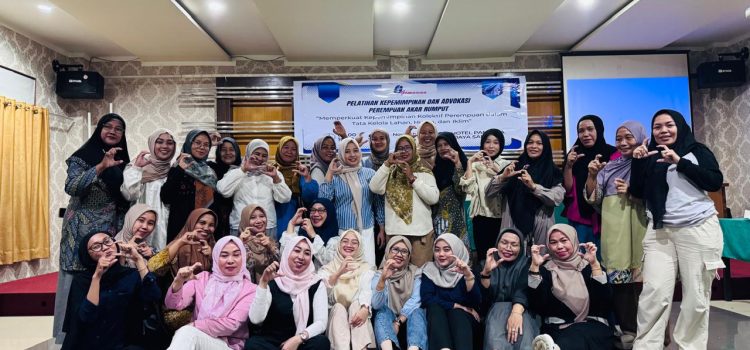
Gemawan organized a grassroots women’s leadership and advocacy training program themed “Strengthening Women’s Collective Leadership in Land, Forest, and Climate Governance.” The two-day training took place on November 5–6, 2026, at Hotel Pantura in Sambas.
The training brought together 24 participants from 15 villages supported by Gemawan, including Lubuk Dagang, Penakalan, Sekuduk, Sumber Harapan, Gapura, Matang Segarau, Arung Parak, Merabuan, Arga Pura, Sempalai, Rantau Panjang, Sempadian, Tambatan, Sengawang, and Trigadu.
Participants included members of women’s groups currently supported by Gemawan, as well as women from communities that will become part of the organization’s future empowerment programs.
Representing Gemawan, Deddy Wahab explained in his opening remarks that the training was designed to strengthen women’s ability to understand power relations and gender inequalities, develop collective leadership, formulate advocacy strategies, and establish a shared platform for solidarity and collective action in land, forest, and climate governance.
“This grassroots women’s leadership and advocacy training aims to strengthen leadership capacities and build a collective platform that enables women to advocate for their rights, influence decision-making processes, and actively participate in gender-just and sustainable land, forest, and climate governance,” Deddy Wahab said.
Through the training, participants were expected to deepen their knowledge and critical awareness of leadership, gender justice, power relations, and rights to natural resources.
The program also sought to strengthen women’s groups in developing collective leadership and organizing around shared interests.
Beyond leadership development, the training provided a space for women to identify the priority challenges affecting their communities, particularly those related to access to and control over land, forests, livelihoods, and the impacts of climate change on women and their families.
Deddy emphasized that strengthening women’s capacities requires sustained efforts through collective learning, community organizing, and advocacy.
With continued support, women can move beyond being viewed merely as beneficiaries of development programs and become influential actors in shaping policies and decisions concerning natural resource management in their communities.
Leadership Grows Through Learning and Experience
Siti Rahmawati, Gemawan’s District Officer in Sambas, affectionately known as Wati, facilitated a practical session on leadership and strengthening women’s organizations.
During the session, she emphasized that effective leadership develops through a long and consistent learning process rather than emerging overnight.
“Becoming a leader is a process that requires time and consistency. No one becomes a great leader from the very beginning,” Wati said, drawing nods of agreement from participants.
The training featured several facilitators and a series of participatory learning sessions and discussions covering women’s leadership, gender justice, power relations, rights to natural resources, community organizing, and advocacy strategies.
Participants were also encouraged to develop collective actions to advance women’s interests at both village and regional levels.
These discussions provided opportunities for women from different communities to exchange experiences, reflect on shared challenges, and explore ways to strengthen their collective voice in decision-making processes.
Transformative Feminist Leadership for Ecological Justice
Laili Khairnur, Executive Director of Gemawan, emphasized that transformative feminist leadership is an instrument of social change that goes beyond meeting quotas for women’s representation.
Rather, it represents a collective commitment to transforming power structures so they become more equitable, inclusive, and environmentally conscious.
This leadership approach places grassroots women at the center of decision-making, recognizing them not as marginalized participants but as key actors who have the right to shape and control their living environments, protect food sovereignty, and safeguard forests and land.
For Gemawan, nurturing transformative feminist leadership means challenging patriarchal biases and structural inequalities while building the foundations of resilient communities capable of responding to the climate crisis at the grassroots level.
Such leadership recognizes that women’s experiences, knowledge, and participation are essential to achieving sustainable and equitable natural resource governance.
By strengthening women’s collective capacities, the initiative also seeks to create opportunities for communities to develop solutions that reflect their own needs, priorities, and environmental realities.
Building Solidarity and Collective Action
Through this leadership and advocacy training, Gemawan hopes to strengthen solidarity and collective leadership among participating women.
The initiative is expected to encourage the emergence of women’s groups that are more empowered, critically aware, independent, and actively involved in decisions concerning land, forests, and climate change.
By connecting leadership development with grassroots organizing and advocacy, Gemawan aims to support women in becoming stronger voices in the governance of the natural resources on which their communities depend.
Ultimately, the training represents an ongoing effort to ensure that women are not only included in discussions about land, forests, and climate change but are also able to influence decisions and collectively shape a more just and sustainable future.
Written by: Waty