
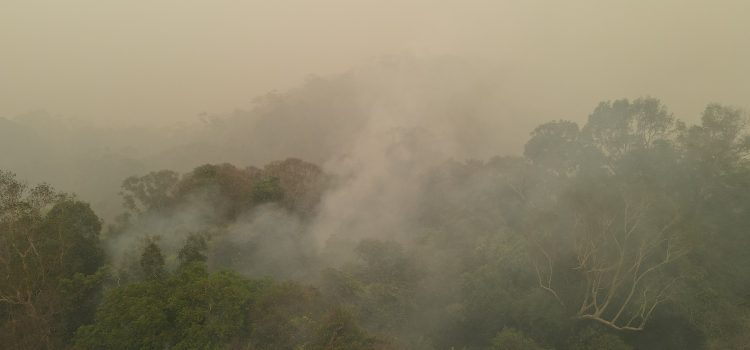
The Publish What You Pay (PWYP) Indonesia Regional Kalimantan Coalition argues that forest and land fires cannot be viewed merely as a consequence of prolonged dry seasons. Recurring fires point to fundamental problems in land governance, permit oversight, and law enforcement, while also testing the government’s commitment to addressing climate change.
These concerns were raised during an online media discussion titled “A Decade After the Paris Agreement: Demanding Accountability for Forest and Land Fires, Evaluating Government Performance and Climate Commitments in Kalimantan,” held on Sunday (October 25, 2026).
The discussion featured Arniyati, Manager of Gemawan’s Training & Learning Center; Buyung Marajo, Coordinator of Pokja 30 East Kalimantan; Among, Director of Perkumpulan PADI East Kalimantan; and Fathur Roziqin Fen, Regional Executive Director of WALHI East Kalimantan. The discussion was moderated by Ageng from Gemawan.
“Emission reduction targets can hardly be considered a success when fires continue to recur, oversight remains ineffective, violations are not consistently addressed, and communities remain exposed to haze without adequate protection,” Ageng said in his opening remarks.
West Kalimantan: Fires Occur in Concession Areas, Communities Bear the Consequences
Arniyati described the forest and land fire situation in West Kalimantan and its impacts on air quality and community livelihoods. In recent days, the air quality index in Pontianak had ranged between 400 and 500. Since July 2026, approximately 40,000 hectares of land had reportedly burned across the province, with hotspots concentrated in Ketapang and North Kayong regencies.
According to Gemawan’s records, more than 70 percent of the fires occurred on concession land, including areas under Right to Cultivate (Hak Guna Usaha/HGU) permits that had not yet commenced operations. Meanwhile, a study by CELIOS estimated that the economic losses caused by forest and land fires in West Kalimantan reached approximately Rp5.4 trillion to Rp5.6 trillion in a single month, approaching the size of the provincial budget.
Arniyati emphasized that these findings should serve as a basis for evaluating the effectiveness of fire prevention and oversight, particularly in areas controlled by permit holders.
“When fires continue to recur, we need to ask not only who is extinguishing them, but also who has failed to prevent them, who benefits from the current system of land governance, and who should be held responsible for the resulting losses,” Arniyati said.
She also highlighted the impacts of forest and land fires that have not been adequately accounted for in disaster management policies. Families have had to spend additional money on masks, seek access to limited healthcare services, and purchase internet data for children forced to study from home.
“Communities cannot continually be expected to remain resilient and adapt. Children here now say there are three seasons: the dry season, the rainy season, and the haze season,” she remarked.
Beyond the impacts on households, Arniyati raised concerns about reductions in village funding under government efficiency measures, which could weaken support for Community Fire Brigades (Masyarakat Peduli Api/MPA). These community-based groups play a crucial role in preventing fires at the village level.
Gemawan advocates shifting forest and land fire management from emergency response toward measurable prevention. This approach should include oversight of land ownership and management structures, investigations into every fire incident, peatland ecosystem restoration, and comprehensive assessments and remediation of impacts suffered by communities.
Gemawan also calls for forest and land fire risk maps to serve as a foundation for regional planning and budgeting. Additionally, a publicly accessible dashboard should integrate hotspot data, burned areas, peatland distribution, HGU and concession boundaries, air quality, and law enforcement developments to enable transparent public oversight.
East Kalimantan: Thousands of Hectares Burned Within Concession Areas
In East Kalimantan, forest and land fires have occurred amid mounting pressures from extractive industries, including coal mining, oil and gas operations, oil palm plantations, and forestry activities. These challenges have been compounded by shrinking regional fiscal capacity, fuel shortages, and the impacts of haze on local communities.
Buyung Marajo cited records from the People’s Safety Advocacy Team indicating that approximately 16,865 hectares of land had burned in East Kalimantan throughout 2026. Of this total, around 69 percent, or 11,600 hectares, was located within concession areas held by 172 companies.
Meanwhile, data from the East Kalimantan Health Office recorded more than 228,000 cases of acute respiratory infections (ARI) across nine regencies and cities, with the highest numbers reported in Samarinda and Kutai Kartanegara.
Buyung cautioned that these figures must be interpreted carefully because respiratory infections have multiple causes, although the increase in reported cases coincided with deteriorating air quality caused by forest and land fires.
“Responding to this crisis requires more than extinguishing fires, distributing basic necessities, or handing out masks. What we need are policies that prioritize people’s safety through prevention, transparency, and law enforcement,” Buyung emphasized.
He argued that recurring forest and land fires cannot be separated from natural resource governance systems that create opportunities for rent-seeking practices while increasing the risks of environmental degradation and social conflict.
“In the extractive sector, there are always four recurring problems: corruption, destruction, conflict, and criminalization,” he said.
Pokja 30 urged the government to safeguard funding for essential public services, including education, healthcare, clean water, sanitation, and social protection, particularly for vulnerable communities affected by the fires.
The organization also called for healthcare services for residents exposed to haze, public access to forest and land fire data and lists of companies operating in burned areas, environmental audits of affected concessions, and transparency in disaster management budgets.
Protecting Indigenous Communities and Ending the Stigmatization of Traditional Farmers
Forest and land fires are also closely connected to how governments and the public perceive Indigenous land management practices. Among rejected narratives that portray traditional farmers and Indigenous communities as the primary causes of forest and land fires.
He explained that traditional farming practices within Indigenous communities follow established procedures that take environmental conditions into account, including land preparation, monitoring wind direction, and conducting controlled burning within limited areas.
“Current regulations have become a red carpet for business interests and capitalists,” Among said.
Nevertheless, Among acknowledged that civil society movements must also engage in internal reflection and remain attentive to burning practices carried out under the name of local communities.
Arniyati added that traditional farmers’ use of fire must be understood within a broader social and economic context. As agricultural markets become increasingly concentrated around oil palm commodities, some communities face limited choices in managing their land and maintaining their livelihoods.
Therefore, addressing forest and land fires requires examining structural problems, including unequal land control and the economic options available to communities, rather than simply placing blame on local residents.
PADI, together with other stakeholders, is currently advocating for officially recognized Indigenous territories in East Kalimantan to be incorporated into the provincial Spatial Planning Framework (Rencana Tata Ruang Wilayah/RTRW).
Such recognition is considered essential to providing legal certainty over Indigenous communities’ living spaces and strengthening protection for their customary territories.
Ten Years After the Paris Agreement, Climate Commitments Must Translate into Concrete Policies
Fathur Roziqin Fen of WALHI East Kalimantan argued that recurring forest and land fires reflect development policy choices that have yet to place community safety and ecosystem sustainability at the forefront.
According to Fathur, a decade after the Paris Agreement, various climate commitments, including Indonesia’s Nationally Determined Contribution (NDC) and the Forest and Other Land Use Net Sink 2030 (FOLU Net Sink 2030) target, have not been adequately reflected in tangible changes on the ground.
“From the Paris Agreement and the updated NDC to FOLU Net Sink 2030, in 2026, all of these commitments seem to mean nothing,” he said.
Fathur also highlighted the imbalance of authority between central and regional governments in managing forest and land fires.
In East Kalimantan, areas covered by Forest Utilization Business Permits (Perizinan Berusaha Pemanfaatan Hutan/PBPH), which fall under central government licensing authority, reportedly account for the largest number of hotspots and the greatest extent of burned land. Yet regional governments also bear significant responsibilities and financial burdens in firefighting operations.
He emphasized the need to distinguish between extinguishing fires and correcting the policies that allow them to recur. While firefighting is necessary to stop the immediate spread of flames, it does not adequately address land control, concession oversight, or accountability for environmental damage.
“We have consistently demanded that the state place the safety of people and ecosystems above the interests of exploitation,” he said.
Fathur encouraged the public and the media to broaden their scrutiny beyond hotspot counts and burned land areas to examine who controls the affected land, the beneficial owners of companies, the sources of business financing, and the buyers of their products.
He also raised concerns about limitations in legal strategies used in forest and land fire cases. According to Fathur, litigation related to these fires since 2015 has not reached the level of company owners.
He therefore called for stronger climate litigation strategies capable of extending accountability to those responsible for corporate decision-making, including through cross-border legal approaches where applicable.
PWYP Indonesia Regional Kalimantan Coalition Demands Accountability from the Government and Concession Holders
In light of these concerns, the PWYP Indonesia Regional Kalimantan Coalition urged the central government, provincial and district governments, the Indonesian House of Representatives (DPR RI), regional legislative councils (DPRD), and law enforcement authorities to take concrete measures to prevent forest and land fires and ensure accountability for their impacts.
The coalition outlined eight key demands:
1. Prioritize landscape-based fire prevention. The government must shift from emergency response toward planned prevention, using forest and land fire risk maps as the basis for regional planning and budgeting.
2. Ensure follow-up action on fires within concession areas. Every hotspot within concession boundaries must be verified and investigated. The government should disclose information about land status, permit holders, investigation findings, and any legal or administrative measures taken.
3. Disclose licensing and corporate ownership data. Forest and land fire data, permits, and concession information should be integrated and made publicly accessible, including beneficial ownership information for companies holding concessions affected by fires.
4. Conduct environmental audits and enforce the law. The government must evaluate corporate compliance in burned concession areas, consistently address violations, extend accountability to responsible decision-makers, and ensure that court rulings are enforced.
5. Guarantee protection for affected communities. The government should provide healthcare services for residents exposed to haze, protect essential public service budgets from reductions, and strengthen support for Community Fire Brigades and village governments.
6. Ensure transparency in disaster management budgets. Public funds allocated to forest and land fire management must be disclosed and made subject to public oversight.
7. Recognize and protect Indigenous peoples’ rights. The government must incorporate Indigenous territories into spatial planning, protect customary land management areas, and end the stigmatization and criminalization of traditional farmers.
8. Demonstrate climate commitments through concrete policies. The Paris Agreement, NDC, and FOLU Net Sink 2030 must be translated into tangible decisions concerning licensing, spatial planning, oversight, and law enforcement rather than remaining merely targets and policy documents.
A decade after the Paris Agreement, this milestone should serve as an opportunity to evaluate how effectively climate commitments have protected communities and ecosystems.
For the PWYP Indonesia Regional Kalimantan Coalition, the success of climate policies cannot be measured solely through emission reduction targets. It must also be assessed through the state’s ability to prevent environmental destruction, ensure transparency, address violations, and restore the rights of affected communities.
The continued recurrence of forest and land fires demands more than firefighting operations. It requires a willingness to critically evaluate land governance, make concession ownership and control transparent to the public, and ensure that those responsible are held accountable for their obligations.