
The urgency and demand for a moratorium on mining permits is being voiced once again. This time it comes from the island of Kalimantan, an island rich in natural resources, including extractive resources. Mining products from this island are one of the pillars of state revenue across various sectors: oil and gas, bauxite, coal, and other types of mining.
However, behind this massive extractive activity, the island of Kalimantan is forced to bear a major ecological crisis, resulting in various forms of damage and negative impacts on the environment, as well as on the socio-economic conditions of communities in mining regions.
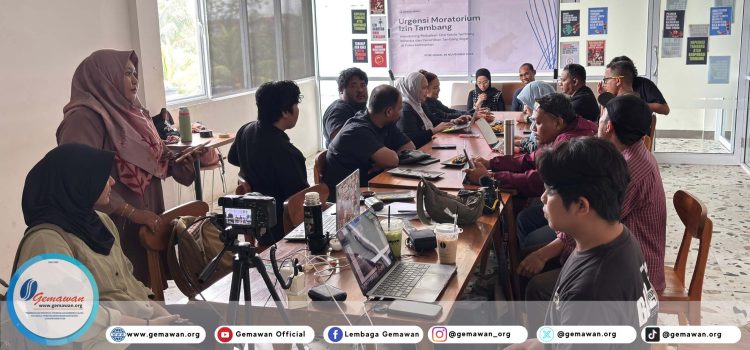
These calls for a moratorium were conveyed in a media discussion themed “The Urgency of a Moratorium on Mining Permits: Promoting Improved Governance of Mineral and Coal Mining and Crackdown on Illegal Mining on the Island of Kalimantan”, held by civil society organizations that are part of the Publish What You Pay (PWYP) Indonesia Kalimantan Regional Coalition. The event took place in a hybrid format in Pontianak, West Kalimantan, on 28 November 2025.
Gemawan West Kalimantan (Kalbar) observes that the benefits of mining are in fact mostly enjoyed by a small group of people, not by the general public. Meanwhile, the negative impacts are felt broadly by society. Ecological crises are increasingly occurring across areas surrounding mine sites, including in West Kalimantan, which is one of the mining regions.
“So far, mining practices have only benefited certain parties, especially corporations. Local communities and Indigenous peoples do not receive significant benefits, and instead have to bear the impacts of ecological damage caused by mining activities. The ecological crisis currently unfolding in West Kalimantan requires the government to impose a moratorium on mining permits. At the very least, a moratorium can become a space for the government to evaluate, so that in the future the benefits of mining can be felt more widely by local communities while still safeguarding ecological sustainability,” said Arniyanti, Head of the Training and Learning Centre (TLC) Division of Gemawan Kalbar.
From WALHI Kalbar, the urgency of a moratorium is discussed in the context of community-managed territories. According to Andre Illu, Head of the Community-Managed Territories Division of WALHI Kalbar, Indigenous peoples have their own capacities to manage areas rich in natural resources. However, in terms of permitting, the state is more occupied with issuing permits than enforcing or reviewing them. This is done without viewing space/territory as a living space for Indigenous peoples. The area is seen merely as a potential or empty space, not as a place where communities live.
“The government has failed to implement equitable spatial planning. The state often acts to secure, or becomes the security apparatus for, investment. A moratorium will not solve all mining problems. But at the very least, a moratorium provides room to reorganize the mining sector for the better, while creating space to protect communities,” he said.
Lack of Transparency in the Mining Sector, East Kalimantan Demands a Mining Moratorium
In East Kalimantan (Kaltim), Pokja 30 highlights two crucial issues in mining: the implementation of mine reclamation and the still-limited transparency of public information. According to the Coordinator of Pokja 30, Buyung Marajo, implementation of reclamation is often not carried out optimally. Some even fail to comply with regulations. On the other hand, there are abandoned mine pits left unreclaimed, which have claimed lives, including children who drowned in former mining pits.
“This situation is clearly caused by weak oversight and the high costs of reclamation, which make companies reluctant to conduct it. In East Kalimantan, the region is already overcrowded with various types of permits, the largest and most numerous in the country. This extractive industry is wasteful and voracious in its use of land, inevitably displacing people’s living spaces. Mining is carried out in the name of investment to pursue regional and national revenues. Meanwhile, within the mining rings, prosperity is an illusion—except for pockets of poverty that prolong people’s suffering. Until now, the government’s seriousness as a regulator and supervisor must still be questioned in light of the damage that has occurred,” he said.
At the same time, public access to information about mining remains very limited. The obligation and compliance with transparency requirements by mining companies and the government is seen as half-hearted. This ranges from convoluted procedures for accessing information to slow responses to information requests related to mining. “Access to information is difficult and slow. Enough with issuing these permits—it is time for a moratorium on mining permits. Those who do not comply must be dealt with firmly, as proof that this country is sovereign,” he stressed.
Mining Fuels a Biodiversity Crisis on the Island of Kalimantan
Meanwhile, Perkumpulan PADI Indonesia Kaltim views the urgency of a moratorium from the perspective of mining’s impact in causing a biodiversity crisis and harming Indigenous communities. Deforestation and forest degradation caused by mining have led to the loss of biodiversity. According to PADI, East Kalimantan holds 38 percent of the national coal reserves, with mining concessions covering 1.5 million hectares. Twenty-nine percent of these concessions are located in forest ecosystems—including 55,561 hectares of primary forest.
PADI defines the impacts of mining on Indigenous peoples as including: loss of livelihoods such as farming and hunting; loss of access to clean water; increased human–wildlife conflict due to disrupted forest habitats; criminalization and intimidation of Indigenous peoples who seek to defend their rights; land grabbing of customary territories; and the erosion of cultural identity.
“Because of the damage caused by poor management of natural resources, Indigenous peoples’ living spaces are increasingly destroyed, and they are constantly subjected to criminalization when they defend their territories—not to mention the damage to biodiversity,” said Among, Coordinator of Perkumpulan PADI Indonesia Kaltim.
Previously, the urgency of a moratorium had also been raised by civil society organizations spread across Sumatra, Java and Nusa Tenggara, Sulawesi, North Maluku, and Papua, who are part of the PWYP Indonesia working group. The various perspectives they conveyed, grounded in the ecological crises caused by mining activities in those regions, underscore the importance of a moratorium on permits in the mining sector.
“This moratorium is a necessity in the current governance of the mining sector. The pace of environmental recovery is no match for the massive issuance of permits by the government. This is compounded by weak oversight and law enforcement in this sector. What we see instead is ecological damage and destruction, which undoubtedly harms communities,” said PWYP Indonesia researcher, Ariyansah NK.