
Bananas have long been an integral part of daily life in Matang Segarau Village, Tekarang Sub-district, Sambas Regency. Nearly every corner of the village is home to thriving banana plants that yield abundant harvests. Yet behind this abundance lies a challenge commonly faced by farmers and residents alike: low selling prices and produce that often fails to be absorbed by the market.
So far, the utilization of bananas in the village has remained limited. The fruit is mostly sold fresh, the leaves are used for household needs, while other parts are often left unused and discarded. This situation has encouraged efforts to explore ways in which this local commodity can be processed into products with higher added value.
One concrete initiative took shape through a training program on producing banana-flour biscuits, involving members of the PKK Teratai women’s group in Matang Segarau Village.
Ideas Born in the Kitchen
Held in November 2022, the training was attended by 30 PKK members who were divided into small groups. The activities were designed to be simple and interactive. Participants were not only given explanations but were also directly involved in practicing each step of the process.
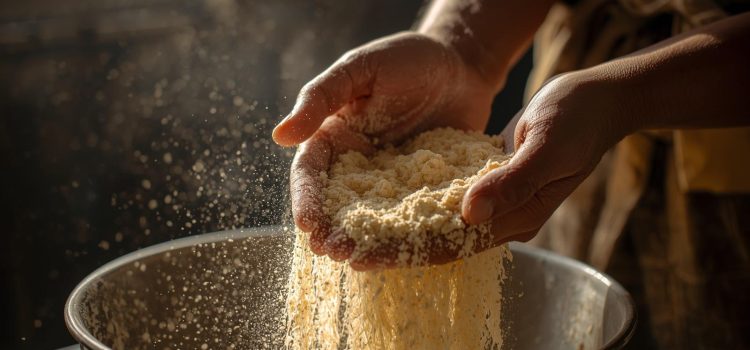
The training covered the conventional production of banana flour—drying the bananas under sunlight, grinding, and sieving—followed by preparing biscuit dough using ingredients commonly found in household kitchens.
For many participants, this was a new experience. Banana flour had previously been viewed as something with little to no use. Through the training, that perception gradually shifted. Bananas that were once sold only as raw produce could now be transformed into snacks that are more appealing and economically valuable.
Banana Flour Biscuits: Simple Process, Promising Results
The biscuits were made without specialized equipment. Conventional ovens, mixing bowls, spatulas, and basic kitchen tools proved sufficient to produce biscuits suitable for consumption. In terms of taste and texture, the biscuits were considered quite good and well accepted by the participants.
The simplicity of the process became one of its main strengths. Besides being easy to replicate at home, the production costs are relatively affordable. It came as no surprise that during discussion sessions, participants began talking about the potential of developing the product into a home-based business.
Questions about market opportunities, pricing strategies, and product storage naturally emerged. This showed that the training went beyond technical skills and successfully sparked entrepreneurial interest at the village level.
Opening Doors to Local Economic Opportunities
With the right approach, food ingredients that were once considered ordinary can gain added value and open up new business opportunities—particularly for women in rural areas.
The enthusiasm shown by the PKK members throughout the program served as a positive sign. It is not impossible that from this simple initiative, a distinctive village-based product could emerge, capable of competing in local markets and potentially beyond.
From Matang Segarau Village, this story serves as a reminder that innovation does not always have to stem from advanced technology. Sometimes, it simply begins in a home kitchen—by making the most of what is already available nearby.
Source: Unira Malang
Image: Canva