
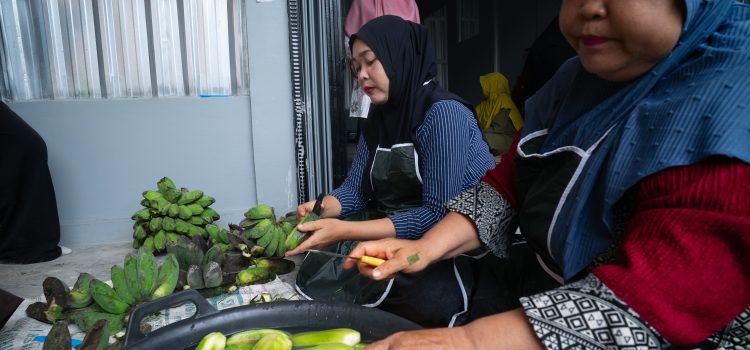
This abundance inspired a group of rural women to create a simple yet impactful innovation: transforming bananas into banana flour, an alternative food ingredient and a high-value local product.
Bananas: Sambas’ Abundant Leading Commodity
Banana plants are among the most common tropical horticultural crops found throughout Indonesia. Hundreds of banana varieties grow across the archipelago. The banana holds high economic value because it can be processed into a wide range of food products — from household-scale snacks to industrial goods.
In West Kalimantan Province, bananas are one of the region’s leading fruit commodities. Based on 2024 production data, the three districts with the highest banana yields are Mempawah (66 million kilograms), Bengkayang (34.2 million kilograms), and Sambas (22 million kilograms). Sambas Regency occupies a strategic position as one of the largest banana-producing centers on the northern coast of West Kalimantan, contributing over 15% of the province’s total banana production, which reached 144.8 million kilograms in 2024.
In Matang Segarau Village, located in Tekarang Subdistrict, one of Sambas’s key agricultural pockets, almost every household has banana trees — whether in backyard gardens or small farms. This abundance inspired a group of rural women to create a simple yet impactful innovation: transforming bananas into banana flour, an alternative food ingredient and a high-value local product.
An Innovation Called Banana Flour
The women’s collective Serikat Perempuan Pantai Utara (Serumpun) in Sambas recognized the banana’s great potential as a raw material for home-based food industries. They began producing banana flour together, in the spirit of communal cooperation that is deeply embedded in Sambas culture. This derivative product is not only long-lasting but also rich in nutritional and economic value.
The idea began with a simple question: how could they prevent abundant bananas from spoiling quickly while also generating additional household income?
The variety used is the kepok (nipah) banana, a local type with firm texture and low water content — ideal for flour-making. The production process is entirely manual, relying on the traditional skills and precision of village women.
The steps begin with peeling the bananas and soaking them in clean water to remove sap and prevent discoloration. The bananas are then thoroughly washed several times until completely clean. Next, they are shredded into thin pieces using simple tools and sun-dried for one to two days, depending on weather conditions. If sunlight is insufficient, an oven is used to speed up drying and maintain product hygiene. Once dried, the banana slices are ground into a fine powder and sifted to achieve a smooth texture. The resulting banana flour is then packaged and sold for approximately Rp25,000 per kilogram.
From Village Kitchen to Production House
At first, production was carried out on a pre-order basis, as the product was still being introduced to the local market. However, through persistence and teamwork, the Serumpun women’s innovation attracted the attention of the West Kalimantan Office of Food Crops and Horticulture. Recognizing both its potential and social impact, the agency provided support by establishing a village production house and supplying essential equipment such as a drying oven and grinding machine to boost production capacity.
Today, this production house serves as the center of economic activity for the women of Matang Segarau. In addition to producing banana flour, the group also holds training sessions on making banana-flour-based products such as cookies, biscuits, and layered cakes. Thus, banana flour is valued not only for its economic potential but also as a local food alternative to wheat flour, contributing to reduced dependence on imported raw materials.
A Trail of Empowerment from Matang Segarau Village
In Sambas culture, the spirit of umme and belale’ — local values of solidarity and mutual cooperation — forms the soul of every collective activity. From these deeply rooted traditions emerges the strength of rural women to achieve economic independence while preserving cultural heritage and social harmony.
By wisely harnessing the region’s natural abundance, the women of Sambas have proven that economic resilience can grow from simple things — even from the bananas in their own backyards.
Written by: Ersa D. & Mohammad R., Gemawan activists