
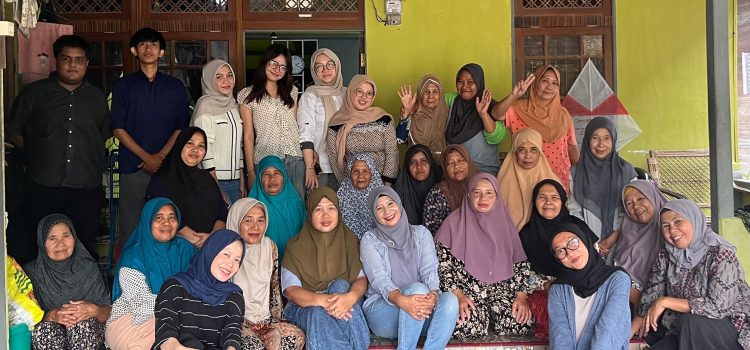
SAMBAS – How can young people truly understand village life, women’s leadership, and environmental challenges if they only learn about them in classrooms? Living alongside local communities and experiencing their daily realities can offer a deeper understanding of these issues.
Through its Youth Initiative: Building Young People’s Critical Awareness Through Field-Based Learning on Grassroots Women’s Organizing, Village Democracy, and Ecological Justice, Gemawan invited six young people to participate in a live-in learning program in Penakalan and Setalik villages, Sejangkung District, Sambas Regency, from October 7 to 13, 2026.
Over seven days and six nights, participants stayed with families belonging to women’s groups supported by Gemawan. In Penakalan Village, they lived with Pariha, a member of the Kamboja Women’s Group, while in Setalik Village, they stayed with Dahlia from the Dahlia Women’s Group.
Through this approach, participants did more than observe village life. They became involved in the communities’ everyday activities, from farming and working in the fields to learning about local livelihoods and participating in village social and cultural traditions.
These experiences allowed young people to gain a closer understanding of how rural communities sustain their livelihoods and preserve local practices. Participants learned about agricultural profit-sharing arrangements, rubber tapping, land management, and sustainable farming practices directly from local farmers.
In Penakalan Village, participants worked alongside farmers to prepare agricultural land, including hoeing, weeding, and learning how crop residues can be used as natural fertilizers.
Meanwhile, in Setalik Village, they explored rubber plantation management and became familiar with traditional games and saprahan, a communal dining tradition that remains an important part of Sambas cultural life.
Learning also took place through ordinary daily activities. Participants joined communal preparations for a wedding, cooked bubur pedas, a traditional Sambas porridge, with village women, attended Islamic study gatherings, and observed activities at local integrated health service posts (Posyandu) and early childhood education centers (PAUD).
These experiences demonstrated that villages are more than places where people live and work. They are also living spaces of knowledge, collective values, and environmental management practices passed down through generations.
Understanding Women’s Leadership and Community Organizing
One of the central focuses of the program was understanding women’s leadership and grassroots organizing in rural communities.
Through discussions with the Kamboja Women’s Group in Penakalan and the Dahlia Women’s Group in Setalik, participants explored how women contribute to family life, economic activities, and decision-making within their communities.
For Tika, one of the Youth Initiative participants, living alongside villagers provided an opportunity to witness firsthand the many responsibilities rural women manage every day.
“Seeing the daily lives of farmers and women in the villages taught me how they manage their time, take care of their households, and work at the same time,” Tika shared.
Aisyah, another participant, had a similar experience. She observed how village women navigate demanding schedules while fulfilling multiple responsibilities throughout the day.
“Watching how busy the women were, from taking care of their homes in the morning to attending Posyandu activities and joining religious study gatherings in the afternoon, made me realize the multiple burdens that women in rural communities carry,” Aisyah explained.
These experiences helped participants understand the double burden and overlapping responsibilities often carried by women. Alongside domestic work, women also play important roles in social activities, economic development, and community life.
Discussions with the women’s groups also created opportunities for intergenerational learning. Young participants listened to the experiences of women who had long been involved in community organizing and gained insight into the challenges they face in fulfilling their social and economic roles.
Learning About Entrepreneurship and Financial Management
In addition to exploring women’s leadership, participants took part in learning activities on entrepreneurship and business financial management alongside local women’s groups.
A total of 28 village women participated in discussions on developing independent businesses, calculating capital requirements and profits, and using digital technology to market their products.
Through practical business finance simulations, participants and women’s groups worked together to identify common challenges faced by home-based entrepreneurs.
These included failing to account for their own labor costs, using raw materials interchangeably for business production and household needs, and difficulties managing production expenses.
For the young participants, these activities offered a clearer understanding of how rural economic challenges are closely connected to everyday life, particularly how women manage resources, develop businesses, and sustain their families’ livelihoods.
According to Ersa, a Gemawan activist, the Youth Initiative was designed to create a learning space where young people could directly observe how rural women’s leadership develops and how principles of ecological justice are pursued at the grassroots level.
“We hope that after participating in this program, the young people will use the experiences they have gained as a foundation for becoming involved in efforts to advance social and environmental justice,” Ersa said.
Connecting Field Experiences with Critical Reflection
Throughout the program, participants engaged in daily reflection sessions to discuss their experiences, observations, and lessons learned in each village.
These reflections played an important role in connecting their firsthand experiences with broader issues, particularly village democracy, women’s leadership, and ecological justice.
The Youth Initiative concluded on October 13, 2026, when all participants returned to Pontianak.
One of the program’s intended outputs was a collection of writings on women and village leadership, developed by participants based on their experiences and observations during the live-in program.
Through learning initiatives such as this, Gemawan seeks to connect young people with the experiences and knowledge of grassroots communities.
Understanding village challenges requires more than reading about them or discussing them from a distance. It requires a willingness to be present, listen, interact, and learn alongside the people who experience these realities every day.
From the villages, young people discovered that knowledge does not grow only within classroom walls. It also emerges from the hands that cultivate the land, the women who organize their communities, and the people who continue to care for the places they call home.
Written by: Dastin, Gemawan