
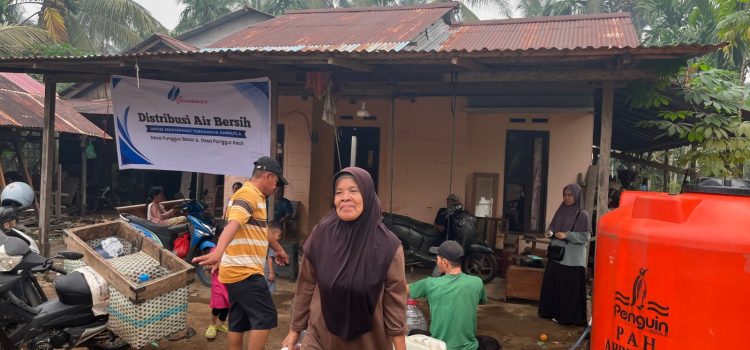
Gemawan distributed drinking water to women’s groups and communities affected by drought and forest and land fires in Punggur Besar and Punggur Kecil villages, Sungai Kakap Subdistrict, Kubu Raya Regency.
The distributions took place on Parit Sarim Road in Punggur Besar on Thursday (September 24, 2026), and Parit H. Maksum Road in Punggur Kecil on Friday (September 25, 2026). Each village received 2,000 liters of clean water supplied by Air Gunung Peniram.
At both locations, residents had been queuing since early morning, bringing water gallons, jerry cans, and buckets to collect water. In Punggur Besar, distribution began at 9:00 a.m. Western Indonesia Time (WIB), and the entire supply was distributed within approximately two hours. Residents brought two to three 19-liter water containers to meet their households’ basic needs.
The assistance came at a time when residents’ water sources were becoming increasingly limited. Rainwater reserves, which had long served as the primary source of water for household needs, had been depleted by the prolonged dry season. Meanwhile, drainage canals surrounding residential areas had begun to dry up, and the remaining water had become salty, making it unsuitable for several daily household activities.
In Punggur Besar, residents even used their previously empty rainwater storage jars to store the clean water provided through the distribution.
Samunah, Chairperson of the Maju Bersama Women’s Group, explained that residents had been struggling to obtain drinking water during the drought. Although clean water assistance had previously reached the village, distribution points were located relatively far away, leaving residents around Parit Sarim frequently unable to access the supplies.
“Alhamdulillah, we are very happy to receive this drinking water assistance. Our rainwater reserves ran out a long time ago, and even getting water gallons has become difficult. The canal in front of our homes has also dried up, leaving the water salty. We cannot even use it to wash vegetables,” Samunah said while queuing for water.
She added that water shortages had forced residents to find alternative ways to meet their daily drinking water needs.
“Clean water assistance has reached this village several times, but the distribution points were far away, so people living around here often missed out. We ended up buying drinking water in plastic cups, but even those have become difficult to find,” Samunah added.
Residents of Punggur Kecil have experienced similar difficulties. Although the residential area received rainfall several days earlier, the collected rainwater remained unsuitable for drinking or cooking. According to residents, the stored water was still contaminated with ash deposits from previous land fires, giving it a brownish color.
For bathing, washing, and toilet needs, residents continue to rely on water from canals in front of their homes, although the water has become increasingly salty as water levels have receded.
Zainab, a resident of Punggur Kecil, said that the condition of the canal water not only made daily household activities uncomfortable but also damaged household utensils.
“We usually rely on collected rainwater for washing and cooking, but when it runs out, we have to buy bottled water. This season, however, even buying water gallons has become difficult. For bathing, washing, and toilet needs, we use water from the canal in front of our house. But the water has become salty because the water level has dropped. Our skin feels sticky after bathing, and washing dishes with it causes our stainless-steel utensils to rust,” Zainab explained.
The shortage of clean water has also increased the financial burden on households. With refillable drinking water becoming scarce, some residents have had to purchase branded bottled water at considerably higher prices.
Nazela, Chairperson of the Generasi Hijau Muda Group in Punggur Kecil, revealed that residents could spend approximately Rp20,000 per day just to meet their drinking water needs.
“We usually buy refillable drinking water gallons, but supplies have become scarce and limited. As a result, we have had to purchase branded bottled water, which is significantly more expensive than refillable gallons. We can spend around Rp20,000 a day on drinking water alone,” Nazela explained.
According to Nazela, the clean water assistance has helped residents secure enough drinking water for several days. However, she hopes that access to clean water will receive greater attention in government policies so that communities do not have to face the same difficulties every dry season.
“We are extremely grateful for the free clean water assistance. It is a relief to know that we have enough drinking water for the next few days. We hope the government will pay greater attention to clean water availability because water is essential to life. Ensuring access to clean water should be a priority in government programs,” she emphasized.
The clean water crisis in both villages has also affected residents’ social and economic activities. In Punggur Besar, communities that depend on canals for domestic use and their livelihoods have struggled to wash harvested root crops, water their plants, and meet their bathing, washing, and sanitation needs.
Saniyeh, a member of the Maju Bersama Women’s Group in Punggur Besar, said that the prolonged drought had also disrupted agricultural productivity. Areca palm trees had stopped producing fruit, rice planting could not begin because the soil and canals surrounding the fields had completely dried up, and chili plants and vegetables had died.
“During this dry season, our areca palms have not produced any fruit, and there are no signs of flowering. We also have not been able to plant rice because the soil and canals around our fields have completely dried up. Our chili plants and vegetables have died. With our crops destroyed, we have had to buy vegetables at prices much higher than usual. We hope the rain will come soon,” Saniyeh said.
The distribution of clean water in Punggur Besar and Punggur Kecil represents an emergency response to the needs of communities facing drinking water shortages amid the prolonged drought and the impacts of forest and land fires. The assistance is expected to ease residents’ daily difficulties while encouraging greater attention to restoring water sources and ensuring sustainable access to clean water for local communities.