
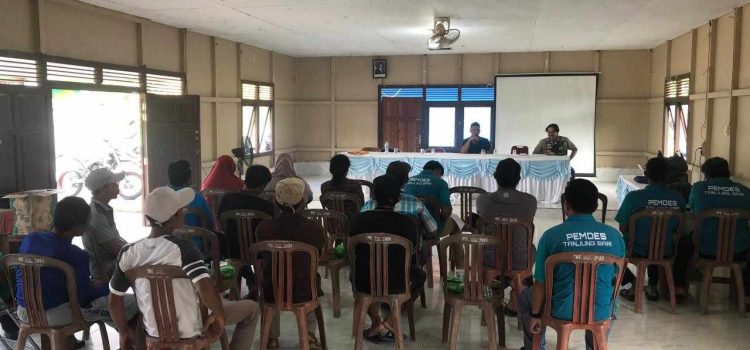
GEMAWAN continues to strengthen community-based economic development efforts through mentoring and mapping of agricultural potential in its assisted villages. In April 2026, GEMAWAN carried out a series of consolidation, coordination, and Focus Group Discussion (FGD) activities with farmers, farmer groups, village governments, and local stakeholders in Nanga Nuak Village and Tanjung Sari Village, Melawi Regency.
These activities are part of the Improving Community Commodity Based Economic Movement in West Kalimantan program, which aims to update data on farmer groups and flagship village commodities, while also identifying potential, challenges, farmers’ needs, and opportunities for developing more sustainable agricultural businesses.
From the results of mentoring and discussions in both villages, it was revealed that the agricultural sector remains the primary source of livelihood for the community. Various commodities such as lowland rice, local rice, vegetables, horticultural crops, rubber, oil palm, and even hydroponic produce support the household economies of farmers.
In Nanga Nuak Village, the main potential lies in developing local rice varieties such as Padi Robi or Padi Tuah, which have high adaptability to local environmental conditions. The village also has six active farmer groups that serve as the foundation for agricultural development. Meanwhile, in Tanjung Sari Village, the diversity of agricultural commodities offers significant opportunities for village economic development, including the emergence of hydroponic farming initiatives that are beginning to show promising market prospects.
Despite this great potential, the FGD results indicate that several issues remain common challenges. In both villages, the institutional capacity of farmer groups has not yet functioned optimally as a platform for capacity building and joint enterprise. Some groups still serve merely as administrative tools to access aid, while their functions in organizing production, marketing, and improving farmers’ bargaining power have not been fully realized.
Additionally, farmers continue to face various obstacles, including limited access to fertilizers and production inputs, a lack of technical assistance, high farming costs, and weak access to market information. Dependence on middlemen also results in low bargaining power for farmers, and the prices of agricultural products are often unfavorable.
In Nanga Nuak Village, another challenge is dependence on rain-fed rice field systems, which makes production highly susceptible to weather conditions. Meanwhile, in Tanjung Sari, farmers complain about the influx of products from outside the region at more competitive prices, making it difficult to market local produce.
Through a participatory SWOT analysis process, farmers, along with village governments and the GEMAWAN team, succeeded in mapping the various strengths, weaknesses, opportunities, and threats affecting the development of the agricultural sector. The results of this analysis serve as a basis for formulating more targeted follow-up plans according to community needs.
Moving forward, GEMAWAN will promote the institutional strengthening of farmer groups through more intensive mentoring, capacity building for farmers through training and field practice, the development of collective enterprises, and building connectivity with agricultural extension officers, relevant agencies, and market partners.
Furthermore, strengthening market access and developing fairer partnerships will be key priorities so that farmers can not only increase production but also obtain added value and market certainty for their products.
This series of activities demonstrates that the villages in Melawi Regency possess significant agricultural potential for development. However, this potential requires sustainable support through institutional strengthening, farmer capacity building, improved market access, and stronger collaboration between the community, village governments, and various related parties.
Through a participatory approach based on the real needs of the community, GEMAWAN hopes that the development of the agricultural sector will not only increase farmers’ incomes but also strengthen long-term food security and village economic independence.
Source: Argumen