
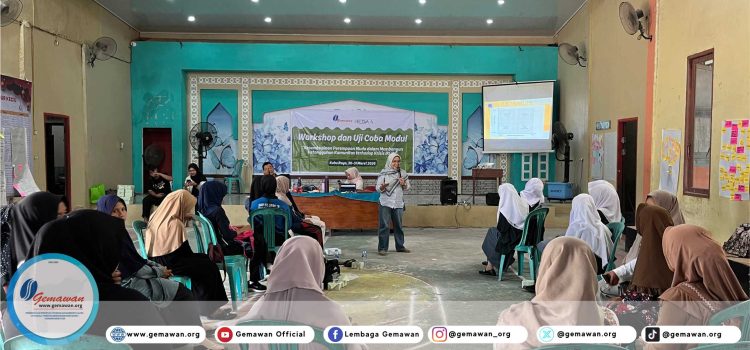
In the midst of the increasingly real threat of the climate crisis touching the domestic and productive spaces of rural communities, Gemawan held a workshop and module trial titled “Young Women’s Leadership in Building Community Resilience to the Climate Crisis.” The activity, which took place over two days, March 30–31, 2026, at the Punggur Kecil Village Hall, Sungai Kakap District, Kubu Raya Regency, became a crucial moment for young women to take on leadership roles in protecting local ecosystems.
Targeting young women in Kubu Raya, the participants in this activity numbered 30-40 people from various backgrounds, including students from SMK Negeri 1 Sungai Kakap, students from MAN 1 Kubu Raya, and women’s groups assisted by Gemawan from Punggur Besar and Punggur Kecil villages. This workshop was designed to disseminate research results related to young women’s leadership, share good practices from the village level, and strengthen capacity through the practice of learning modules developed based on local experiences.
This workshop was not only a space for knowledge transfer but also a forum for reflection on the experiences of village residents in facing extreme weather changes that affect their lives.
Cultivating Climate Crisis Awareness from the Grassroots
The Head of Punggur Kecil Village, Adi Kusumajaya, in his opening speech, emphasized the importance of involving the younger generation as the inheritors of the future of the environment. He appreciated Gemawan’s initiative in targeting young women as key agents of change in the village.
“Agendas like this are crucial for fostering knowledge and enthusiasm among young people. We need a generation that is not only aware but also cares and takes action on the issue of the climate crisis. I hope that through this workshop, fresh ideas will emerge from young women to help build a more resilient village,” said Adi Kusumajaya on (03/30/26).
The Reality of Gender Inequality and Climate Impacts
Through this workshop, Gemawan wanted to highlight the root of the existing problem: gender inequality. Participants were invited to dissect how social constructions often place a heavier burden on women when crises occur. Through Focus Group Discussions (FGDs) and film reflections, similar patterns were found in the field.
Participants divided into discussion groups voiced the fact that when floods or extreme weather occur, women visibly bear a double burden. While men often focus on other efforts such as firefighting (during land fires) or outdoor work, women struggle to save household goods, care for children, and ensure food availability in emergency conditions.
“Many clothes pile up, unable to dry because of the rain, harvest yields decrease, while household affairs must still be completed. This is what we feel as a double burden during difficult seasons,” said Juliana, representing the participants in the discussion forum on (03/30/26).
This discussion also revealed gender inequality in the economy, such as wage differences for farm laborers in Punggur, where men are paid higher, at Rp 70,000, compared to women who only receive Rp 40,000 for half a day’s work, even though their workload is equal or even heavier.
Women’s Leadership as a Solution
Dati Fatimah, a researcher presenting Gemawan’s research findings, provided a methodological framework for participants to understand that the voices of young women are invaluable. The module being trialed emphasized that women’s leadership is not just about holding formal positions but the ability to organize communities and advocate for policies that are responsive to women’s specific needs.
Nazela, a member of a Gemawan-assisted group, felt a change in perspective after participating in the series of activities.
“We are learning together as young people to protect the environment. We cannot completely stop climate change, but we can prevent its impacts by engaging in activities that see nature as our future,” asserted Nazela on (03/31/26).
Encouraging Inclusive Policy
Rahmawati, a Gemawan activist, emphasized that the ultimate goal of this two-day workshop is part of an effort to strengthen development policy. Through this workshop and module trial, Gemawan wants to ensure that all data and gender injustices affecting young women can be documented in a learning module that can be adopted more widely.
“We hope this activity can encourage the wider adoption of the learning module and strengthen gender-responsive and sustainable development policies and practices. Village development must not leave out women’s voices, especially in facing climate challenges,” concluded Rahmawati.
Author: Ersa – Gemawan Activist