
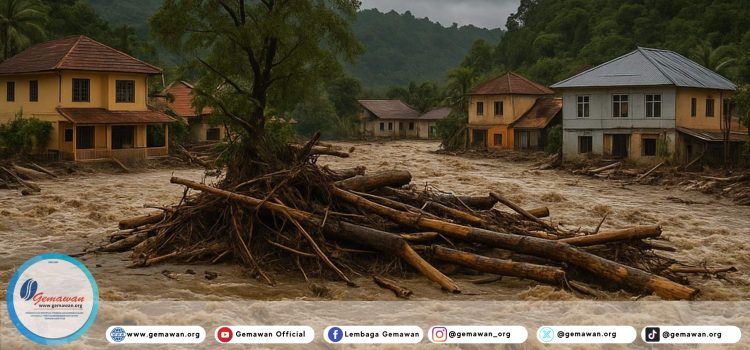
Every time we witness major floods in Aceh and Sumatera, we are not just seeing suffering far away. There is a feeling that suddenly seems familiar, like seeing our own reflection on the surface of murky water. We feel compassion, but also unease, because that story is not foreign to West Kalimantan. Between Aceh, Sumatera, and West Kalimantan, there are traces that all point toward a slow-moving destruction that is becoming ever harder to contain. Forests are shrinking, oil palm is expanding as if it knew no boundaries, and policies are often quicker to grant permits than to think through the long-term risks.
In Sumatera and Aceh, floods come again and again, carrying logs from the uplands and mud from soil that has lost its support. We can no longer blame the rain. These disasters are born of a voracious Anthropocene: of hills cut open without pause, of rivers forced to bear loads far greater than their natural capacity. When the roots that once held the soil together are gone, water simply follows the laws of nature. It flows across the lowlands, destroys settlements, and leaves behind a trail of grief that keeps repeating itself.
West Kalimantan should read this story as a mirror, not just as distant news. Because the same pattern is beginning to appear here. WALHI West Kalimantan notes that throughout 2024 the province lost more than 39,000 hectares of forest cover. Gemawan adds that over the last two decades West Kalimantan’s primary forest has shrunk by more than 1.2 million hectares. These are not small figures.
Areas that were once green have turned into open land. Plantations continue to expand, mines keep pushing their boundaries, and permits often glide smoothly through the process, bypassing serious ecological risk assessment. Perhaps we still feel that West Kalimantan is not yet as bad as some parts of Sumatera. But if policy directions remain the same, it is only a matter of time before the same bitter reality arrives.
This story cannot be separated from the relationship between the state, corporations, and communities. The state carries a moral and legal obligation to protect its citizens. Within the framework of the UN Guiding Principles on Business and Human Rights, the state has a duty to prevent harm that can trigger disasters. Yet in Aceh and Sumatera we see how permits are issued without adequate ecological studies, how law enforcement loses out to negotiations that are not always transparent, and how oversight often ends up as paperwork that is never fully implemented. When protection mechanisms are weak, it is the people living along rivers, in the uplands, and on hillsides who first bear the consequences.
Companies also shoulder a significant responsibility. The principle of respecting human rights does not only mean not directly harming people. It also means not destroying the ecosystems that are home to human life. Many companies arrive with promises of prosperity, but are not always honest about the risks. They clear vast tracts of land, alter landscapes, and often fail to conduct comprehensive social and environmental impact assessments. In several areas of West Kalimantan, WALHI and civil society organizations are finding similar patterns. Protected forests are felled, rivers are polluted, and Indigenous communities are excluded from processes that should honor their right to free, prior, and informed consent.
West Kalimantan is not unfamiliar with the consequences. The massive flood in Sintang that lasted for weeks was a sign that the Kapuas River too can lose its patience. Water entered schools, markets, and people’s homes, underscoring that this is not merely a natural disaster. It is a policy-made disaster. Nature is simply showing the result of human choices.
Yet honest reflection does not stop at assigning blame. Reflection is a space to reorder ourselves. The experiences of Aceh and Sumatera teach us that once forests are gone, there is no technology that can restore their functions in a short time. Reforestation demands persistence across generations. It requires commitments that do not shift with every change of political leadership.
West Kalimantan, in fact, has strong moral and social resources. Indigenous communities protect forests as they would protect their own pulse. There is knowledge passed down through rituals, through customary ways of opening and closing land, through ways of reading rivers and seasons. These traditions are ecological and spiritual capital that many other regions do not have. If the state is willing to listen, if companies are willing to show respect, if spaces for participation are truly opened, then disaster risk can be reduced, and West Kalimantan does not have to repeat the tragedies of Aceh and Sumatera.
The warning letter from those two regions has now arrived before us. The question is no longer whether we know the causes. We do. The real question is whether we are willing to learn and to change. If not, when the rivers overflow again, we will no longer be able to say that the disaster came suddenly.
West Kalimantan still has hope. That hope lies with those who greet the river every morning, who plant trees without seeking publicity, who care for the soil while teaching their children that nature is a friend, not an object to be exploited. If we choose to side with life in this way, West Kalimantan can safeguard its future. All of us can still tend this land as a meeting place between humans and nature where both protect each other, instead of wounding one another.
Sopian Lubis,
Resident of West Kalimantan; Managing Director, Religion and Society in Southeast Asia Initiative (RSEAI)