
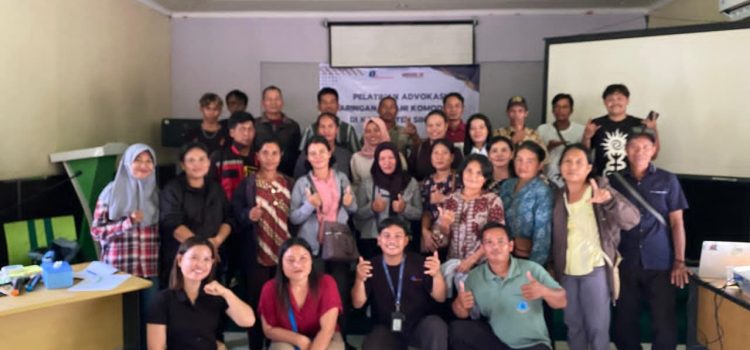
Gemawan facilitated the Farmers’ Advocacy Training for Commodity-Based Farmer Networks on Monday, January 19, 2026, at the Botany Hall of the Sintang Regency Agriculture Office. The training served as a strategic effort to strengthen farmers’ capacity to identify agricultural challenges while enhancing their advocacy skills in engaging with key stakeholders.
The training was attended by farmer representatives from eight villages in Sintang Regency: Linggam Permai, Benua Kencana, Sekujam Timbai, Kelam Sejahtera, Gurung Mali, Ransi Dakan, Dak Jaya, and Mangat Baru. The session was facilitated by Lani Ardiansyah and moderated by Natalia Kori. From the opening session, participants expressed their hope that the training would serve as a space for sharing experiences, expanding knowledge, and strengthening inter-village farmer networks.
During the first session, participants were divided into four groups based on their main commodities: groundnuts, hybrid maize, rice, and rubber. Through group discussions, farmers mapped out various challenges faced in the field, ranging from limited access to fertilizers and quality seeds, pest and plant disease outbreaks, reliance on basic farming tools, damaged farm access roads, limited market access, and low commodity prices.
Beyond technical issues, participants also highlighted the impacts of climate change, inadequate irrigation systems, and the declining interest of younger generations in the agricultural sector. These findings were jointly analyzed to identify priority issues considered urgent and critical to be addressed through policy advocacy.
The second session continued with an advocacy simulation, replicating an audience meeting between the commodity farmer network and key stakeholders, including Village Heads, members of the Regional House of Representatives (DPRD), the Regent, the Head of the Agriculture and Plantation Office, private sector representatives, and middlemen. In this simulation, farmers directly conveyed their needs for modern agricultural technologies and equipment, continuous training and assistance from agricultural extension officers, and improvements to rural infrastructure that affect crop distribution and price stability.
Through this simulation, participants were trained to articulate their aspirations in a structured, data-driven, and solution-oriented manner. Village government representatives in the simulation expressed their readiness to support farmer networks in conducting advocacy at the district level, while regional government representatives emphasized the importance of cross-sector collaboration, including partnerships with the private sector, to address agricultural challenges.
Farmer representatives assessed the training as highly beneficial, as it reflected the real issues they face daily in the field. They expressed hope that similar activities would continue and reach more farmers across other villages in Sintang Regency.
As a follow-up, the commodity farmer network committed to completing the necessary data and administrative requirements for advocacy within the next two weeks, while also beginning to plan follow-up advocacy training sessions in their respective villages. Gemawan expects this initiative to strengthen farmers’ bargaining positions and contribute to the development of more equitable, sustainable, and farmer-centered agricultural policies.
Source: RRI