
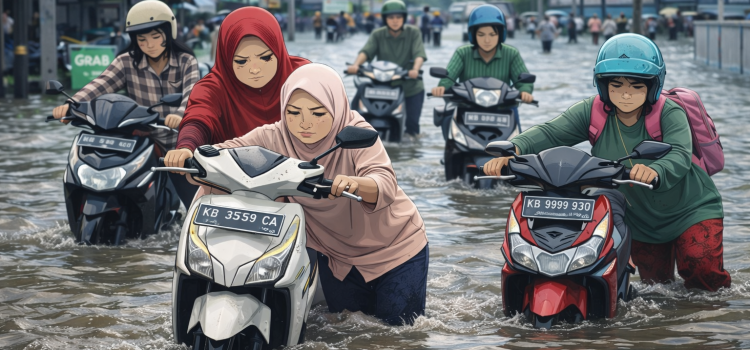
As someone who lives and works in West Kalimantan, I realize that flooding in Pontianak is often seen as merely a city problem. However, what happens in Pontianak is part of a long-standing and extensive story of the entire landscape of West Kalimantan, especially the upstream areas which are the life source of our rivers.
When water rises in the city, I always see it as a reminder that the West Kalimantan landscape is a single, unified ecosystem. Therefore, understanding floods cannot be limited to an urban perspective; we must view the entire Watershed (DAS) as our shared living space.
In recent years, West Kalimantan has been recorded as one of the provinces with the second highest rate of deforestation or forest loss in Indonesia. This massive change in forest cover reduces its ecological function as a guardian of water balance. When forests disappear, water will overflow beyond the river’s capacity.
Latest data shows that flood inundation in Pontianak continues to expand. According to an analysis by the Gemawan Spatial Center, Pontianak has experienced an increase in inundated area; for example, in North Pontianak from 980.10 ha (2018) to 1,115.40 ha (2024) – a 13.81% rise. This proves that technical drainage efforts alone are insufficient to address Pontianak’s flooding problem. Changes in spatial planning, land use activities, and protection of water catchment areas have become critical.
Ecology Does Not Bow to Administrative Boundaries
Gemawan’s accompaniment experiences in various villages have taught me, as a social activist, that water does not recognize administrative boundaries. Therefore, spatial governance also cannot stop at the interests of specific regional leaders. Water flows beyond map borders, so its management must also be cross-regional. This needs to be corrected through an integrated regional management system, especially in the formulation and implementation of the West Kalimantan Spatial Plan (RTRW).
The RTRW should ensure that protected areas, customary forests, village forests, and water catchment areas receive priority protection. Conversely, if the RTRW opens too much space for plantation and mining expansion, the carrying capacity and ecological balance will continue to decline. Floods and the threat of climate crisis will be imminent.
Water Management as Policy, Not Just Mitigation
Floods need to be seen as a long-term policy issue. Improving the watershed system is an important technical step, but it does not address the root of the problem. Strengthening policies to prioritize the protection of conservation areas must be a development agenda for West Kalimantan. Another approach is to side with the community, because it is the community that bears the multiplied impacts of a disaster.
Indigenous community groups and local communities, state administrators at the regional level, and city residents—all have a role. Village forests, customary forests, and the protection of conservation areas must be part of the main strategy. Sustainable spatial governance is the key to facing an increasingly vulnerable future.
From “Acap” to an Agenda for Change
Floods in Pontianak are often considered merely “standing water” – or in Malay, *acap*. But now, this condition can no longer be normalized or viewed as just an annual routine. Flooding is a harsh warning from the environment that our spatial governance is not yet oriented toward sustainability.
Therefore, it feels crucial today to firmly question: to what extent have the policies of the city to provincial governments truly placed flood control as a strategic agenda? Has spatial planning policy integrated protection from other regencies, especially upstream? What climate crisis mitigation measures should be a priority agenda?
As part of Gemawan, I see this not merely as a technical matter, let alone an infrastructure project, but as a political choice regarding space that determines the future of Pontianak and West Kalimantan—or even beyond. Floods are not just *acap*, but an ecological challenge that we must face consciously, measurably, in a planned manner, and through mutual cooperation.
Author: Arniyanti, pegiat Gemawan.