
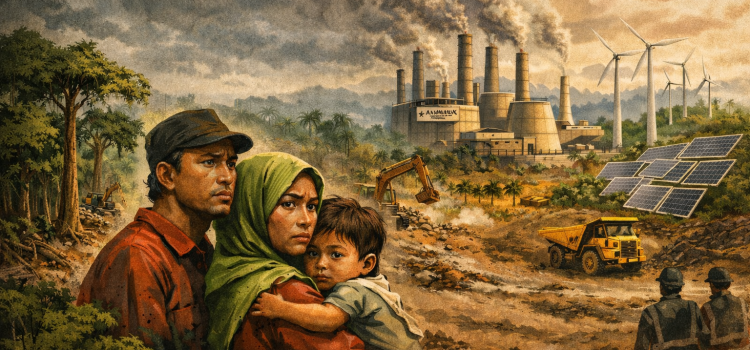
In recent years, the term “energy transition” has been increasingly discussed in national media. The government often portrays energy transition as a solution to the climate crisis and dependence on fossil fuels. However, facts on the ground show that the development of energy transition has the potential to repeat old cycles: the oppression of existing resources and the dispossession of local communities’ livelihoods in the name of clean energy. Forests are reopened, land is repurposed, and local communities once again find themselves in vulnerable positions.
Energy transition is also frequently presented as a governmental solution to the climate crisis. Yet, for local communities in Kalimantan, this energy transition represents a new chapter in an old story: the continual narrowing and vulnerability of local communities’ living spaces, with forests sacrificed in the name of energy transition, forcing local communities to adapt once more to a changing environment.
This unease emerges in nearly all regions, particularly in Kalimantan. Dependence on coal indeed has negative impacts on health and the environment across various areas in Kalimantan. However, the solutions often offered by the government create new problems for local communities, as energy transition clearly requires millions of hectares of land—which is not a fair answer for communities living in direct harmony with nature.
Concerns about energy transition deepen further upon hearing the government’s plan to open 20 million hectares of land for food and energy, wrapped under the name of National Strategic Projects (PSN). Statements claiming that the land used is degraded—meaning land that has experienced a decline in quality and productivity—often do not align with realities on the ground. In many areas of Kalimantan, such land still serves as the living space for local communities. As a result, communities will once again face oppression and displacement in the name of development.
The issue lies in national policies on energy transition, which often move in risky directions. Bioenergy, whether biomass or biofuel, is frequently introduced as renewable energy (EBT) without considering impacts on living spaces and social aspects. Moreover, replacing even a small portion of coal usage requires millions of hectares of land, meaning that the expansion of industrial forest plantations (HTI), oil palm, and land conversion could trigger large-scale conflicts with local communities.
Energy Transition in Kalimantan
In Central Kalimantan, where much of the area is already controlled by forestry, mining, and plantation concessions; in East Kalimantan, where the crisis of living spaces has long persisted and recurs with varying policies; and in South Kalimantan and West Kalimantan, where the expansion of biomass, oil palm, and mining further narrows community management spaces—all of this demonstrates that energy transition is being subtly packaged by the government under the PSN banner without considering the affected local communities.
Behind all this, the role of civil society in Kalimantan has already made a significant impact: Central Kalimantan through strengthening issue literacy and public knowledge production; East Kalimantan through policy advocacy reinforcement; South Kalimantan through grassroots organizing and consistent community-based work; and West Kalimantan through youth consolidation and creative campaigns. All these roles do not stand alone but complement one another. That is why cross-regional collaboration is key, so that the struggle for living spaces and energy justice in Kalimantan can proceed more strongly and sustainably.
Fragmentation of movements also serves as an important reminder. Kalimantan is a living space inhabited by diverse local communities. Maintaining divisions will only weaken the struggle. On the contrary, a direct approach based on shared interests through nature and living spaces will open opportunities for much broader collaboration.
The current situation is not merely about what type of energy will be used, but also about who benefits and who is sacrificed. Energy transition should be a path to repairing injustice, not worsening the existing conditions. If forests are lost, water is polluted, and local communities lose their land, then for whom is this clean and just energy being built? Is it for the government under the pretext of PSN development, or for local communities living in harmony with nature, whose existence is increasingly eroded day by day?
Therefore, energy transition needs to be repositioned toward its original goal: protecting life. It must side with affected communities, respect living spaces, and ensure community participation in decision-making. Without all that, energy transition will merely become a new name for the old patterns that have already occurred.
Author: M. Daffa, volunteer at Gemawan.