
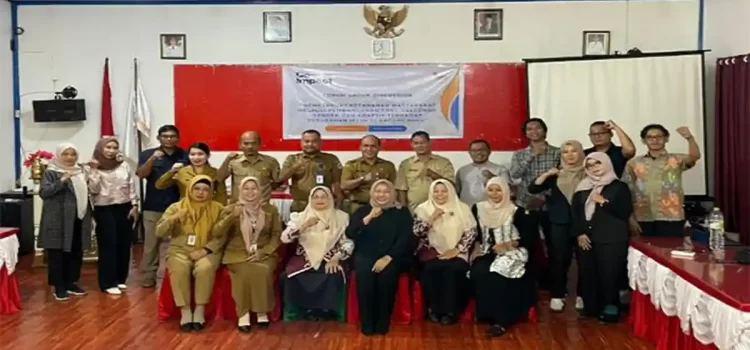
Gemawan is pushing to strengthen women’s role in building community resilience through gender-responsive and climate change-adaptive development in Kapuas Hulu Regency, West Kalimantan.
Gemawan activist Rahmawati said that women, particularly female farmers and indigenous women, face greater vulnerability due to limited access to climate information, technology, economic resources, and decision-making spaces.
“Yet women play a crucial role in maintaining family food security, managing agricultural produce, protecting water sources, and preserving local knowledge related to natural resource management and adaptation to seasonal changes,” she told Tribun Pontianak on Wednesday, June 10, 2026.
According to Rahmawati, women are not merely a group affected by climate change, but also key actors in community-level adaptation efforts.
“Therefore, a gender perspective needs to become an inseparable part of regional development planning and implementation,” she said.
She explained that Kapuas Hulu, as a region with vast tropical forests, strategic river watersheds, and important landscapes in West Kalimantan, now faces various challenges due to climate change.
Shifting seasonal patterns and rainfall, increasing flood risks, drought during certain seasons, and the threat of forest and land fires are phenomena that communities have felt more acutely in recent years.
“These conditions directly impact the lives of communities, the majority of whom depend on agriculture and natural resource utilization for their livelihoods,” she said.
Rural communities, she noted, are the most vulnerable group as they are highly dependent on environmental and weather conditions for their daily economic activities.
Meanwhile, public access to climate information that is easy to understand and apply in daily life remains a challenge.
“The limited reach of information to vulnerable groups, especially women in rural areas, means many communities still lack adequate capacity to anticipate the impacts of climate change,” she explained.
As an effort to address these challenges, Gemawan held a multi-stakeholder dialogue on Tuesday, June 9, 2026. The event aimed to create a discussion space bringing together local government, academics, climate information providers, civil society organizations, media, and community members.
“This forum is expected to strengthen shared understanding of climate change impacts while encouraging the integration of a gender perspective into regional development policies and programs,” she said.
Beyond being a discussion space, the event also served as a platform for sharing knowledge, experiences, and best practices in strengthening community resilience against climate change.
Participants discussed various collaboration opportunities to strengthen a more inclusive climate information system, build community capacity, and ensure that vulnerable groups gain better access to information and resources supporting adaptation.
Specifically, the dialogue aimed to deepen stakeholder understanding of climate change impacts on communities, particularly women in rural areas.
“This event also promotes the integration of a gender perspective into regional development policies and programs, identifies opportunities to strengthen an inclusive climate information system, and reinforces synergy among government, academics, media, and civil society organizations in building community resilience,” she said.
Rahmawati hopes the event will serve as an initial step toward strengthening shared commitment to achieving more inclusive, sustainable, and equitable development.
“Through this forum, we hope to build a common understanding of the importance of integrating gender and climate change issues into regional development,” she said.
Furthermore, the forum is expected to mainstream gender and climate change issues into development policies and programs, improve community access to climate information — especially for female farmers — and forge stronger collaboration among stakeholders.
In doing so, climate-adaptive and socially just development can be achieved sustainably in Kapuas Hulu.
Source: TribunPontianak.co.id | Writer: Sahirul Hakim | Editor: Syahroni