
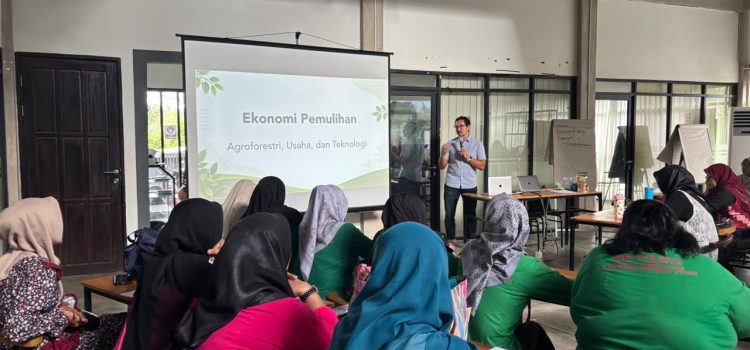
A total of 80 women entrepreneurs and community members from various villages and regions in West Kalimantan participated in the “Gesti Maju Digital” Workshop, organized through a collaboration between Gemawan and Think.Women. The event carried the theme of “Recovery Economy,” focusing on strengthening women’s businesses in harmony with environmental preservation. Monday, (08/06).
The workshop highlighted the importance of the interconnections between agroforestry, business development, and the use of digital technology as efforts to build a sustainable economy. Through this activity, participants were invited to understand that economic recovery is not solely focused on increasing income, but also on restoring and preserving the natural environment as the community’s source of life.
A representative from Gemawan, Maulisa, explained that the participants came from various community groups working in agriculture, fisheries, and natural resource processing businesses. According to her, community economic development cannot be separated from environmental conservation efforts.
“The groups we invited today are specifically from the Pontianak City area, but together with Think.Women, we are not stopping here today. We will also travel to other villages and areas where Gemawan works. Generally, they work in agriculture, fisheries, and other businesses. We are not forgetting the environment, so both can run sustainably to create a lasting economy,” she said.
Meanwhile, Anintya from Think.Women stated that the workshop was an opportunity for participants to get to know each other and learn together in a collaborative space. She explained that the mentoring does not end after the face-to-face activities are over.
“We at Think.Women are collaborating with Gemawan. Today is our first opportunity to meet and learn together. After this session, all participants will be invited to join the community, and later we will meet again through online sessions,” she explained.
Similar sentiments were expressed by Rama from Think.Women, who explained that their organization focuses on empowering women through the use of technology and business digitalization. According to him, a shared vision regarding environmental sustainability is the main reason for the collaboration with Gemawan.
During the workshop, participants received four main materials that form the foundation of business development. The first material discussed Resource and Market Mapping as an initial step to transform existing local potential into business opportunities. Next, participants learned how to determine the right products by considering ease of production and market opportunities.
Other materials covered production processes and pricing strategies, as well as how to determine the appropriate market based on product characteristics. Participants were also introduced to the use of digital technology and marketplaces as a means to expand their marketing reach.
Through discussion sessions, participants shared their experiences regarding the challenges they face in running their businesses. One participant, Sul, who processes cassava into food products, admitted to gaining new knowledge about raw material processing techniques.
“I usually make cassava products, but the color often turns dark. From this discussion, I received advice to steam it briefly and add oranges or lemons to preserve the color and prevent it from changing,” she revealed.
In addition to strengthening production capacity, participants were also invited to see the opportunities of digital marketing, which can expand their consumer reach. During the session, it was explained that business owners who previously only sold products in their local neighborhoods could now reach a wider market through digital platforms such as marketplaces.
“In the past, we could only sell around our homes. When products are marketed through marketplaces like Tokopedia or TikTok Shop, buyers are not just from the neighborhood but can come from various regions,” the facilitator concluded.
Through the “Gesti Maju Digital” Workshop, Gemawan and Think.Women hope that more and more women in West Kalimantan will be able to develop businesses based on local potential, utilize digital technology, and maintain environmental sustainability as the foundation for community economic development.